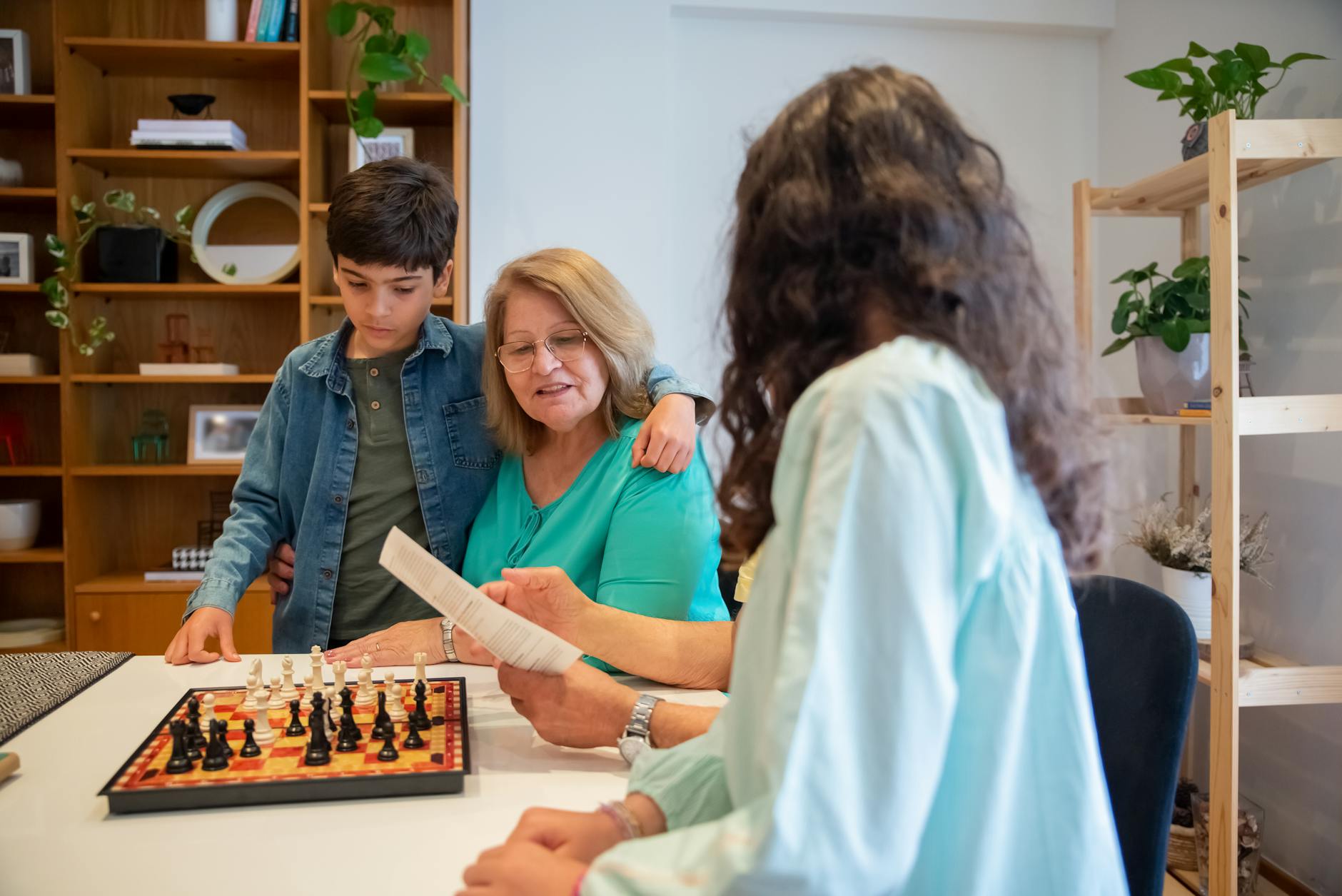
Playing board games as a family is such a great way to build strong bonds with your children! Almost any game you play together will be fun, but some games are perfect for stoking the thinking skills of gifted and advanced learners, too. Here are a few game gift ideas that were my family’s favorites, faves of my gifted students over the years, or new games I discovered in my research. I hope you love these ideas! (Please note: This article contains a few links to Amazon. As an Amazon Associate, I earn from qualifying purchases.)
Game Ideas
Zingo — Zingo is like a mini-Bingo game but uses pictures and words. It helps children with pre-reading and reading skills and can have up to 6 players (ages 4+). There are actually two other versions of this game: Zingo Word Builder and Zingo 1-2-3 Number Bingo, both also for ages 4+.
Why this is a great game for gifted children: Because gifted children often pick up early reading and pattern recognition quickly, Zingo’s fast pace and matching of pictures + words give them a chance to accelerate the fluency of recognizing word‐image links. The “two levels of play” help them self‐differentiate: one side is easier; one side is more challenging. Also, the quick tile‐dispensing and competition to call out a match gives them a mental speed‐boost, which many gifted children enjoy when they’re ready for more challenge.
Blokus — this strategy game is easy to learn and designed for families. My gifted students used to love to play this game during indoor recess (ages 7+).
Why this is a great game for gifted children: Blokus gives children a rich spatial/visual reasoning workout: they must mentally rotate, flip, and plan placement of pieces while also considering how opponents might block them. Researchers note that strong spatial reasoning predicts STEM success. (Games for Young Minds)
Moreover, it’s quick to learn (“less than a minute of rules”) but hard to master – exactly what many gifted kids prefer: depth without drag. (familygamesquad.com)
The fact that it requires both strategy (what will I place) and defense (how can I block you) makes it ideal for children who need high‐ability challenge and like to think ahead.
No Stress Chess — Chess is an excellent game for two players and definitely helps players to develop strategy. I taught all of my boys to play chess when they were in first grade, so it’s definitely possible for young children to learn chess. I came across this great ‘teaching’ version of chess to help children more easily learn the game (ages 7+).
Why this is a great game for gifted children: Chess is often called the “ultimate strategy game” — playing it helps children develop logic, visualization, planning, and self‐regulation. (RIGHT BRAIN CHILD)
No Stress Chess in particular scaffolds the rules via cards so children don’t get frustrated trying to remember how pieces move; instead they can focus on the strategic part. (My Little Poppies)
For gifted students, who often crave a deeper challenge, this version offers the doorway into full Chess without the steep learning curve, enabling them to engage sooner and confidently.
Scrabble– If you love words, and your children love competing with big words, then classic Scrabble is for your family (ages 8+). Don’t forget The Official Scrabble Dictionary if you plan to enact the “challenge” rules to your game as well as Scrabble Score Sheets to better organize your scorekeeping.
Why this is great for gifted children: Scrabble isn’t just fun—it’s a serious literacy and cognitive workout. It encourages vocabulary expansion, spelling proficiency, and strategic placement of words to maximize points (e.g., through double/triple letter and word scores). (Sanako)
Gifted children, who often have strong verbal aptitude and enjoy word‐play, can really dive into the strategic side (tile tracking, board geometry, probability of remaining letters). (Mensa for Kids)
Plus, playing with others allows them to articulate word choices, justify strategy, and build metacognitive awareness about how they think—important for upper‐elementary/high‐ability learners.
Apples to Apples– The point of this game is to make comparisons among different cards and convince the rest of the players to vote for your comparison as the best one. I have fond memories of playing games such as APPLES TO APPLES with our boys, and my husband winning the game based on his ability to persuade the boys that a “Witch” was slipperier than my card- a “Worm!” I’ve never laughed so hard while playing a game as I did when playing this one (ages 12+). There is also a version for younger kids, too- Apples to Apples Junior (ages 9+).
Why this is a great game for gifted children: This game taps into higher‐order thinking: making connections between seemingly disparate ideas, persuading others, reasoning about which pairing the judge will prefer—and even thinking about meta‐perspective (What is the judge’s mindset?). (giftedissues.davidsongifted.org)
For gifted children, who often enjoy complex ideas and are capable of seeing multiple viewpoints, Apples to Apples provides a fun social context for that thinking. It also builds verbal reasoning, vocabulary (since cards include diverse nouns/adjectives), and the joy of clever argumentation.
Final thoughts for choosing games for gifted learners:
- Choose games that provide depth, flexibility, and the opportunity for advanced thinking (strategy, spatial reasoning, meta‐cognition).
- Make sure they are playable by your child’s current skill but have “stretch” for where they can grow.
- Use family game time not only for fun, but as rich interaction: ask your gifted child to explain their thinking (“Why did you choose that word? Why did you place your piece there?”).
- For each game you bring into your home/classroom, consider extension prompts for gifted students: e.g., “Design a new rule that increases the challenge,” “What if we flipped the goal?” “How can you use this game to teach someone younger?”
- Rotate games frequently so gifted learners don’t lose interest and continue to be challenged.
- Use the game time not only for fun but for verbal debrief: ask them to reflect on strategy (“What worked? What surprised you?”) and metacognitive thinking (“How did you decide? What would you try differently?”).
- Encourage siblings or mixed-age play: gifted children can mentor younger siblings, which strengthens their own thinking as they explain and scaffold.
I hope my game picks spark a playful and enriching game night with your children during this holiday season. Are you familiar with any of the games on this list? If so, how do your children like the games? Please list your other game suggestions in the comments below! ~Ann






 Teaching for Talent