Hello, teachers and parents! I recently wrapped up my series on the National Association for Gifted Children’s Annual Convention Session Reviews. Before that, I published a fifteen-part series on gifted identification. Now I am ready to move into the next logical topic: Delivery of Service.
Identification and service delivery must work hand-in-hand. A school division’s identification system should reflect the gifted program it offers, and those programs are defined by the services they provide. Ideally, the service model should guide the identification process. However, I wanted to begin with gifted identification because it is essential to understand what giftedness means and how we recognize advanced potential before exploring how we support it.
Over the next several weeks, I will walk through ten of the most widely used service delivery models in gifted education. Many divisions blend multiple approaches, and that flexibility can work beautifully when it is intentional and aligned. I am excited to dive into these models with you and unpack what makes each one effective.
To start the conversation, I would love to hear from you. What service delivery model does your school division use, and what is one positive attribute of that approach? Share your thoughts in the comments below!
Today I got to watch one of my Gifted & Talent Development Resource Teachers defend her dissertation (she passed!). Her dissertation explored the talent development journeys of students preparing for careers in aviation. Grounded in Gagne’s Differentiated Model of Giftedness and Talent (DMGT), her work examined how real learners move from early interest to emerging competence. While the study centered on future pilots, the lessons extend to every content area and every student with potential waiting to be developed.
One of the strongest messages from the study is that talent begins with discovery and access. Students first become interested in a domain when they encounter an experience that lights a spark or when an adult opens a door. Gagne’s model reminds us that natural abilities are only the starting point. What matters most is how opportunities, environments, and people shape those abilities over time.
Mentoring surfaced as one of the most powerful catalysts for growth. Effective mentors validated students’ thinking, taught them how to approach problems, expanded their network, and suggested next steps. In DMGT terms, mentors act as key catalysts who help transform raw interest into growing talent. This applies across all subjects. When young people have adults who invest in them, their confidence and competence accelerate.
Another lesson is the importance of belonging. Students thrive when they feel welcomed, represented, and supported within a domain. Without belonging, even strong motivation can falter. Creating inclusive learning environments is not an extra. It is a core condition for talent to flourish.
The students also emphasized that abilities are learned– there was no such thing as innate flying ability. Progress came from practice, guidance, and repeated exposure to challenging tasks. Barriers such as confidence, time, and financial constraints affected pacing, but growth continued when support systems remained steady.
For educators, the takeaway is clear. Talent development requires intentional relationships, meaningful experiences, integrated learning, and access to real-world contexts. When we understand talent as a long-term developmental process, not a fixed trait, we create more pathways for students to discover who they can become.
These lessons from my teacher’s study reinforce that talent development can be a truly powerful model for student growth in their passion area. Do you have examples from your school division of students growing along the talent development trajectory? Let us know in the comments below! ~Ann
My mentor and international gifted education guru, Dr. Joyce VanTassel-Baska
Wow! I have to say that I thoroughly enjoyed going through all of my notes from the 2025 NAGC Annual Convention to create the 12 session reviews I’ve been posting for the past 2 weeks or so. Writing them brought everything I learned at the convention into clear focus, and this process helped me decide on the takeaways that I must share with my staff. Some of the big ones are:
My school division is on the right track with using MTSS to serve talent development and gifted education (see MTSS, IEPs, and AI and Leveraging MTSS).
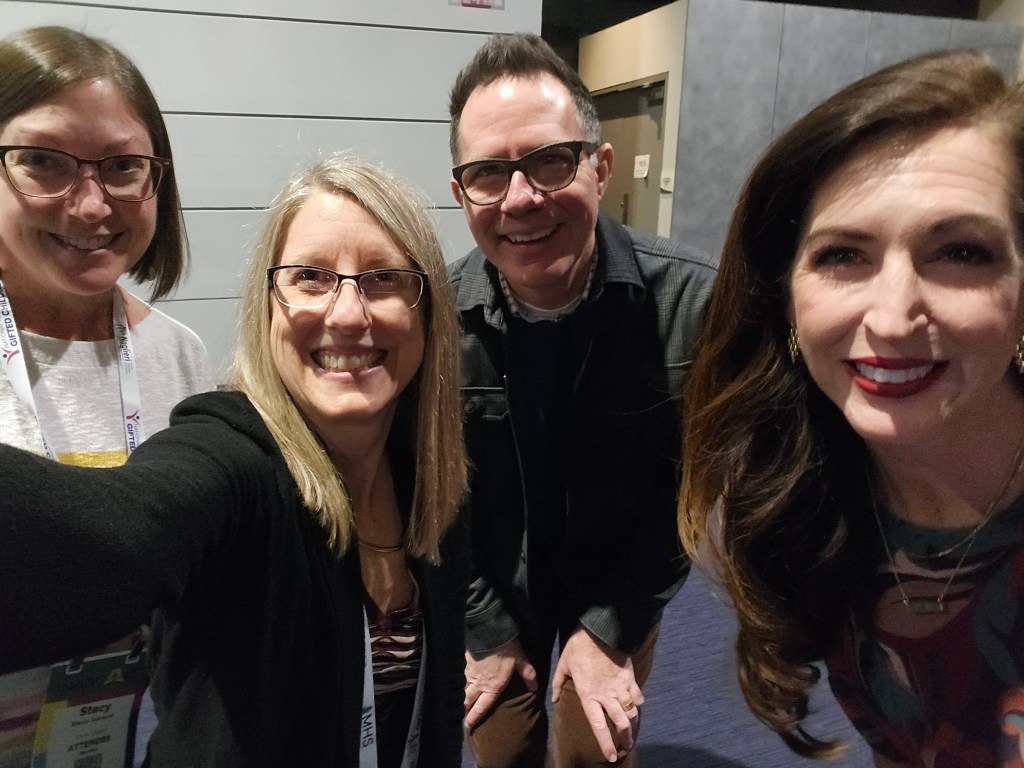
My favorite moment from #NAGC25 was seeing my mentor and favorite professor ever- Dr. Joyce VanTassel-Baska! She taught me gifted classes at William & Mary back when I did my Master’s degree in Elementary Education with my endorsement in Gifted Education, mentored me for 14 years through several of my gifted teaching jobs, then taught me again for my Doctorate in Gifted Education Administration before she retired (I’ll have to share the story one day of how she convinced me to finally apply for my doctorate). Anyway, I was in a session right next door to hers, and as soon as the session ended, I scooted right over into the room in which she was presenting and waited on the side for the throng of people to drift away from her. She happened to look to the side, saw me, and her face lit up and she said, “Annie!” It was wonderful to get to see her and to catch up just a bit. Hopefully, you can see the joy on my face in the picture above. Well, I hope that this Gifted Education Conference review series was meaningful for you and that you, too, had some takeaways from the information I shared. Was it? Is there something you learned from my review that you’d like to discuss? If so, please add your thoughts in the comments below. I can’t wait to read them! ~Ann
This year at NAGC25, I had the privilege of presenting alongside Dr. Kimberly Beckerdite from Newport News Public Schools (VA) and Esther Gencheva from Baltimore City Public Schools (MD) on a topic that is both urgent and energizing: how intentional Talent Development practices can expand access to gifted services for students who are too often overlooked. Our three districts represent different contexts, from suburban to large urban systems, yet we share a commitment to one central idea: Talent is universal, but opportunity is not. When schools create structured, research-informed systems that nurture early potential, more students are able to show what they know and can do.
We opened with a simple truth drawn from the work of Del Siegle and colleagues: before talent can grow, students must have authentic opportunities to demonstrate strengths (see article). This means moving beyond a narrow view of giftedness and giving all students opportunities to do challenging things. Effective talent development involves purposeful exposure to challenging higher order thinking skills (such as Harvard’s Project Zero Thinking Routines), hands-on tasks, and high quality discussions that activate strengths that standardized tests alone may miss.
Across Baltimore City, Newport News, and Williamsburg-James City County, our teams have some talent development strategies in common for our K-2 students such as conducting Talent Development Push-In Lessons and providing robust teacher training in gifted characteristics and ways to nurture talent. Another talent development strategy we all had in common was utilizing the Legends of Learning Analogies Program to teach our students analogical thinking skills. This program has hands-on activities and digital game-based experiences that allow students to think critically, solve problems, and show growth from pre-to-post tasks involving verbal, non-verbal, and quantitative analogies. The data has been powerful. For example, Newport News saw seventy-two students qualify for gifted services after using the program, with ninety-five students moving on to the next round, all from Title I schools. Baltimore City continues to use the Legends of Learning Analogy Program to raise identification rates by providing direct support to schools with the lowest representation. In my small school division, early data from our two Talent Development schools will help us refine talent development instruction and strengthen our gifted identification process through triangulated evidence.
Each of our divisions is now expanding its talent development work by:
Providing more training for teachers.
Supporting more intentional Tier I rigor in all classrooms.
Teaching more integration of clear thinking routines.
Committing to more support for families.
Talent Development is not a program. It is a mindset. When schools commit to nurturing early strengths, more students begin to shine. If you attended our session, thank you for joining the conversation. Share in the comments what you thought about our work so far. If you would like our handouts or want to learn more, feel free to reach out to me. The work is worth it because our students are worth it! ~Ann
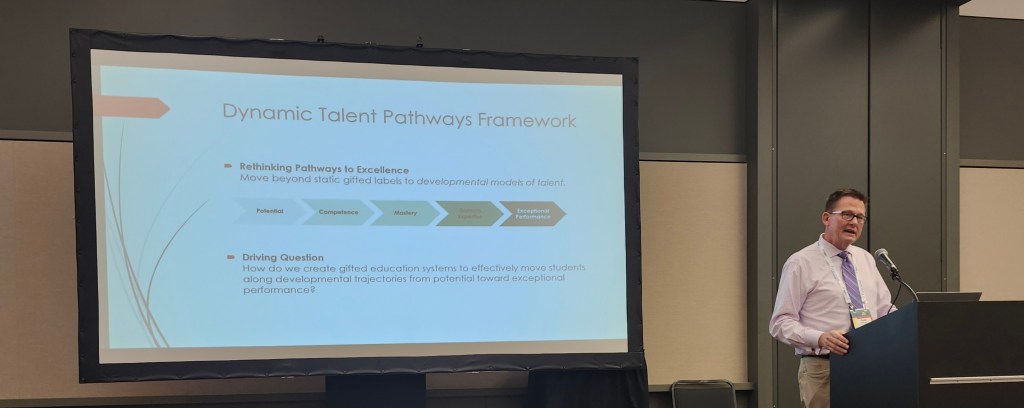
Felicia Dixon, PhD (Ball State University) and Todd Kettler, PhD (Baylor University) started this session with a reminder: in our work with gifted adolescents, our role is not to teach students what to think, but how to think. To help achieve this goal, Dr. Kettler offered a bold redefinition of secondary gifted education due to the pressures of college readiness, equity, and AI integration. His idea is called the “Dynamic Talent Pathways (DTP) Framework.” At its core is a belief that excellence and innovation are complementary, not competing- excellence reflects depth, rigor, sustained growth, and flourishing; innovation introduces new tools, structures, and partnerships that expand access to that excellence. The model merges talent development frameworks with the science of exceptional performance to re-envision secondary gifted education.
The Dynamic Talent Pathways Framework
This model pushes us beyond identification, static gifted labels, and serving gifted students toward developmental trajectories: Potential → Competence → Mastery → Domain Expertise → Exceptional Performance. The guiding question becomes: How do we move students along this pathway?
There are five theoretical frameworks upon which DTP is built:
Giftedness in adolescence begins as early potential within specific domains, but potential alone is not enough. Talent emerges when that potential is systematically developed into competence, expertise, and a growing commitment to a field. This means secondary gifted education must focus not only on performance but on identity formation. Students need opportunities to see themselves as mathematicians, writers, scientists, and creators engaged in meaningful work. When adolescents begin to internalize these identities, they gain a sense of purpose and long-term motivation that supports continued growth.
Contextual and Ecological Talent Development
Because talent is contextual, its development depends on the ecosystem that surrounds each learner. Growth is nurtured within interconnected systems that include family, school, peer networks, community partners, and broader cultural influences. Secondary schools play a critical role as ecosystem architects by designing environments, pathways, and relationships that help students move from potential toward expertise. When these supports align, students experience the kind of sustained challenge and encouragement that allows their abilities and identities to truly flourish.
Three Interwoven Strands of Talent Development
The DTP Framework is built on three mutually reinforcing strands:
1. Cognitive Mastery Acceleration, differentiated curriculum, inquiry-based learning, seminars, dual enrollment, mentorships, and independent research all strengthen domain-specific understanding. Metacognition and self-regulation become non-negotiable skills.
2. Creative Production Students engage in authentic problem-solving through design labs, innovation challenges, artistic residencies, and research projects. Assessment focuses on creative contribution rather than standardized measures.
3. Identity and Purpose Formation Through reflection, narrative work, advisory seminars, and mentoring, students connect talent to purpose and ethical engagement. Portfolios track their evolving intellectual and personal growth.
A key tool: Talent Development Plans—living documents co-created with mentors that define domain focus, short- and long-term goals, mentorship connections, and milestone experiences (performances, publications, competitions).
Context Matters: The Ecological Lens
DTP positions talent as something nurtured within nested systems—family, school, peers, community, and culture. Secondary schools function as ecosystem architects, shaping the conditions in which giftedness becomes talent.
Instructional Design & Teacher Roles
Instructionally, the model calls for inquiry and project-based learning, mentorship structures, “talent incubators,” and developmental (growth-oriented) assessment. Teachers become Talent Scouts, Learning Designers, and Developmental Mentors, supported by professional development in metacognition, affective needs, scaffolding, and creative problem-solving.
What This Means for Schools
Expected outcomes include expanded excellence, sustained engagement, equitable access, and purposeful contribution. It also invites us to rethink programs: moving away from rigidity, allowing mastery-based credit in non-strength areas, building micro-accelerations in elementary, and, above all else, prioritizing student flourishing over course collecting.
A Future-Focused Vision
The future of secondary gifted education lies in local collaboration, hybrid learning environments, data-informed talent development, and new ways of defining professional expertise. Most of all, it lies in creating conditions where gifted adolescents don’t just achieve- they thrive.
I found this presentation to be exactly what I needed to hear as my division looks at redesigning gifted programming, K-12. Therefore, this was my 3rd favorite session of NAGC25!
What do you think about Dr. Kettler’s model for secondary gifted programming? Share your thoughts in the comments below. I’d love to hear from you! ~Ann
P.S. By the way, in case you don’t know, Dr. Felicia Dixon is the mother of secondary gifted education! She is the primary editor of The Handbook of Secondary Gifted Education, with the 3rd edition coming out any day now!
One of the biggest challenges in gifted education is not simply designing strong services- it’s building the shared understanding and buy-in needed to make those services work. This session offered a powerful, practical roadmap for aligning Talent Development to MTSS (Multi-Tiered Systems of Support) so schools can support advanced learners equitably and coherently.
What Is MTSS?
MTSS is a system of supports using data-based decision making to ensure a high-quality education for all students (I love this definition of MTSS)! And it does far more than deliver interventions:
It coordinates how academic, behavioral, and SEL systems fit together.
It ensures equitable access to challenge, support, and acceleration.
Where to Start? With the Zone of Proximal Development (for information about ZPD, click here)
If our goal is to maximize growth of our gifted and advanced students, we must ask two essential questions:
Where should advanced learners spend most of their time? In their Zone of Proximal Development, working at the edge of their current competence with appropriate challenge.
Where do they actually spend most of their time? Too often below their readiness level, repeating mastered content or waiting for the rest of the class.
MTSS and Talent Development help close this gap by structuring challenge, support, and opportunity intentionally across a schoolwide system.
Building the Buy-In
A strong system begins with shared clarity and shared responsibility. The presenters cited Tamra Stambaugh, who emphasized that a robust continuum of services is essential, and it must be both horizontal and vertical. Horizontal services ensure that students have a range of opportunities and supports within their current grade level, while vertical services create an articulated path from one level to the next so students don’t lose momentum during transitions. Both dimensions depend on clear, written plans that are understood and embraced across the school community. A continuum matters because students’ learning and developmental needs vary widely, and without a thoughtful structure, we risk mismatching students with services. When done well, a continuum allows us to intentionally align environments, experiences, and supports so every learner can grow at the appropriate pace and depth.
Why Apply MTSS to Advanced Learning?
Districts increasingly recognize that MTSS is ideal for supporting advanced learners because:
It’s a model familiar to educators and leaders.
It frames challenge as a shared, schoolwide enterprise rather than the job of one gifted teacher.
It prioritizes an asset map—what strengths and services already exist in the system and who is responsible for leveraging them.
All students benefit when they have opportunities to explore interests and develop strengths.
Tiers allow for flexibility and equity across readiness levels.
It supports integration of SEL, which is essential for talent development.
The Talent Development Framework and How It Aligns to MTSS
A Talent Development (TD) approach centers on nurturing students’ emerging abilities through domain-focused development, domain-specific growth trajectories, and the understanding that giftedness is something that evolves over time rather than being a fixed trait. It emphasizes deliberately cultivating the psychosocial skills students need to thrive and creating clear pathways that lead toward genuine creative productivity. This approach strengthens MTSS by focusing on developing potential and latent talent, aligning closely with current research on learning, problem-solving, and creativity. Most importantly, TD keeps educators anchored in a strengths-based perspective, especially for underrepresented learners, so that growth for all students becomes both the priority and the expectation.
What Might a Continuum Look Like in Your District?
Dr. Corwith and Dr. Calvert suggested that if we wanted to move to a TD/MTSS continuum in our districts, we should start with looking at our student data to identify students’ relative strengths, readiness levels, and areas needing additional challenge. Then, we can map services to those needs:
Tier I (for ALL): Interest-based learning, strength-based opportunities, embedded enrichment
Tier III: Targeted, intensive services for students with complex or lower-incidence advanced learning needs
Across all tiers: Social-Emotional Learning (SEL) supports that cultivate student agency. Dr. Calvert reminded us that there is no single social-emotional profile for gifted students. Many characteristics commonly attributed to “giftedness” are learned behaviors—perfectionism, for example, is not an inherently gifted trait (Syvia Rimm talks about perfectionism here).
Another suggestion for the TD framework is that malleable psychosocial skills must live in Tier I, so all students learn skills like persistence, collaboration, self-regulation, and intellectual risk-taking.
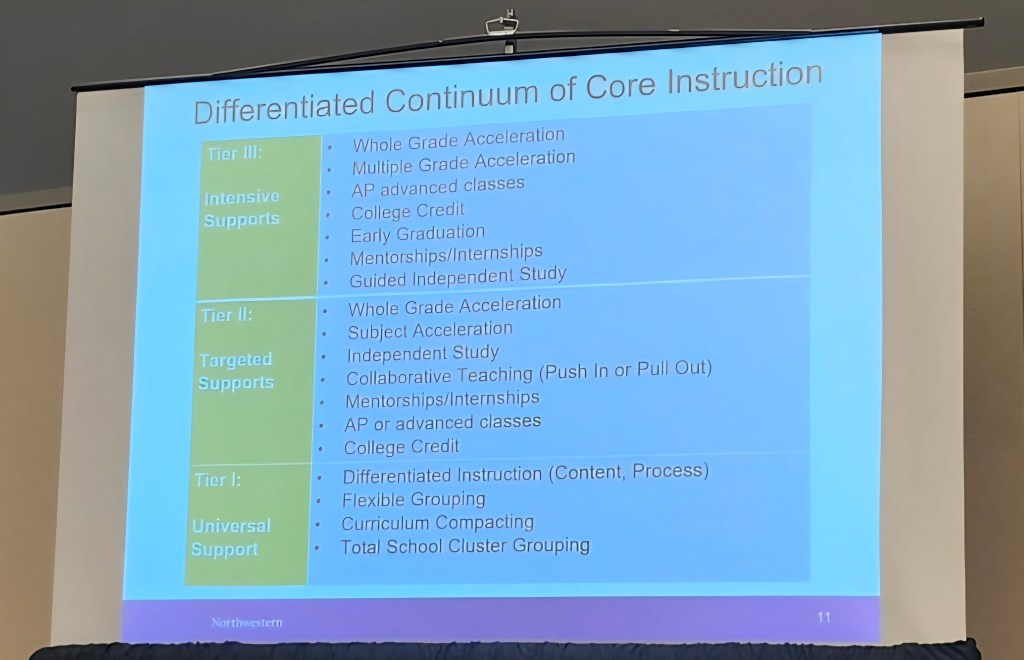
Dr. Calvert shared the idea that districts should offer differentiated continua of services in multiple areas: Core Instruction, Enrichment, Assessment, and Psychosocial Supports. Here is a the example of the Continuum of Core Instruction he gave:
Range-Finding: How Extensive Should the Continuum Be?
Districts can use assessment data to determine how far services need to stretch and which learners fall within each zone of readiness. This process becomes especially important because gifted students often have “peaky profiles” (meaning that their strengths are uneven rather than uniformly high). For students whose readiness levels sit far beyond what typical grade-level grouping can offer, acceleration should be strongly considered. The presenters referenced Peters (2017) who encourages us to ask whether teachers can effectively serve students functioning more than two years above grade level; when the answer is no, acceleration becomes not just appropriate but necessary.
Differentiation becomes significantly more powerful when paired with the right type of acceleration (see my prior discussion about acceleration in my blog review of the Subject Acceleration session; I discuss some of the forms of acceleration that a school district could use). Subject or whole-grade acceleration does not replace differentiation—it enhances it. One way to think about this is through the idea of ZPD × 2: bringing a student’s zone of proximal development inside the teacher’s “zone of possible differentiation.” When acceleration adjusts the starting point, differentiation can operate more effectively and responsively.
Conclusion: Challenges and Opportunities
Implementing a Talent Development approach within MTSS comes with real challenges. Many educators still view MTSS as a structure designed only for special education, a misconception left over from early Response to Intervention (RtI) models. Teachers often need deeper professional learning to differentiate effectively, and schools require clear, efficient policies to guide academic acceleration. Some divisions may also need to expand the courses they offer or rethink how services are organized so that staff are supported rather than overwhelmed. And the reality is that a single gifted teacher in each building cannot meet every need—distributed teaching and shared responsibility are essential.
At the same time, the TD Framework holds remarkable opportunity. Schools can move away from outdated assumptions such as fixed ability or narrow, stereotypical views of gifted learners. They can shift from relying primarily on pull-out services to embracing more comprehensive, schoolwide talent development practices. Families can see that updated service models actually expand opportunities for advanced learning rather than reduce them. Diverse schools, especially those previously disadvantaged under NCLB-era accountability structures, can finally demonstrate the depth of student growth that traditional measures often missed. Most importantly, schools can build a sustainable, consultative approach that supports every learner in discovering strengths and developing talent.
Final Thoughts
This session was another one of my favorites from the convention. Talent Development is near and dear to my heart, and one of my passion areas in the field of gifted education. When I put together all that I learned from Dr. Corwith’s and Dr. Calvert’s session, it seems clear that implementing Talent Development within an MTSS framework isn’t about adding another initiative (MTSS is typically the way schools “do business” anyway). It’s about reimagining how we cultivate potential across an entire system. When schools commit to a continuum of services, embed psychosocial skill development in Tier I, and leverage acceleration and differentiation strategically, they create environments where advanced learners can thrive. With shared responsibility, clear processes, and strong professional learning, MTSS becomes a powerful pathway for equitable, sustainable, and high-impact gifted education.
In gifted education, identification is often misunderstood. Critics ask whether it’s fair for some students to move ahead, or whether we should focus more on learners who are behind. These questions come from a standards-based mindset where success means reaching the same benchmark at the same time. But this narrow view obscures the reality that many advanced learners coast, mask their needs, or disengage because they aren’t given opportunities to grow.
A more useful frame centers on growth. Achievement means every child is learning. Advanced learning means a student can grow at a faster pace or explore deeper content. Gifted identification, then, becomes a tool to match learners to opportunities—not a reward, label, or gatekeeper.
With today’s long history of assessments from early intelligence testing to creativity measures, dynamic assessments, portfolios, and above-grade-level tools, we now have more options than ever. But the heart of modern identification lies in framing for purpose and equity. Before selecting any test or tool, schools must ask: What is the purpose of this measure? What program or support will follow? Many systems still face persistent disproportionality, and one size never fits all. Purposeful identification requires aligning tools with intended outcomes, selecting assessments that reduce or eliminate bias, and making sure the tools and outcomes are aligned to the advanced learning programs we will offer.
Looking ahead, the field must continue to refine practice. This means keeping a clear lens on what works when, where, and for which students. It means developing new approaches that rely less on opportunity-dependent knowledge and more on fundamental cognitive skills. It means expanding dynamic assessments that capture problem solving in action and using course-embedded assessments and rubrics to observe readiness as it unfolds. And as AI tools mature, educators can use them to sort patterns, surface inequities, and support—not replace—professional judgment.
The take-home message is simple: No single tool will ever identify every advanced learner. Testing has value, but only as part of a larger body of evidence. In addition, gifted identification and programming must be designed together with clear goals and a commitment to equity.
When we combine purpose, thoughtful assessment, and responsive programming, we move closer to an advanced learning ecosystem that truly serves all students in a 21st-century landscape (my next session review expands on this idea!).
As I work with my team on revising our gifted education plan for our school division, we will closely audit our identification tools as well as how they each connect to our program offerings. Have you done a similar audit before? What tips do you have for us? Share them in the comments below! ~Ann
Here are my teacher, Mrs. Johnson, and me with Dr. Emily Mofield and Dr. Brian Housand!
This session was HANDS-DOWN one of my favorites that I attended! I learned so much (plus I’m a huge Emily Mofield fan), and I plan to take back everything all my new knowledge to my Gifted & Talent Development Resource Teachers team.
At this year’s NAGC conference, Dr. Emily Mofield (Lipscomb University) and Dr. Brian Housand (University of North Carolina- Wilmington) delivered a session that felt both energizing and grounding. They had a reassuring message for us: the real power of artificial intelligence is found in our ability to remain authentic humans and to help our students do the same. While many educators worry about AI diminishing critical thinking or stripping away authenticity, Dr. Mofield and Dr. Housand showed us how AI can strengthen, not weaken, the traits gifted learners already possess.
Their framework centers around four superpowers our gifted students have that AI does not: courage, curiosity, wisdom, and discernment. When we use AI intentionally, these superpowers grow stronger. When we design tasks that require students to stay in the driver’s seat, AI becomes the sidekick and our gifted learners become the superheroes.
Below is an overview of each superpower and the opportunities they offer.
Courage
Productive struggle is at the heart of gifted growth (see my blog post review about motivation and optimal brain development for more information about this). Courage is what allows our students to stay in the struggle long enough to learn something meaningful. Dr. Mofield demonstrated how we can use AI to make productive struggle visible and purposeful by building custom bots that elevate rigor.
By programming bots with Kaplan’s Depth and Complexity icons, Paul’s Elements of Reasoning, universal themes, and literary analysis tools, she created a Socratic Seminar bot with four personas- The Curious Connector, the Text Detective, the Big Idea Builder, and the Respectful Challenger. These personas push students to consider multiple viewpoints and develop stronger arguments.
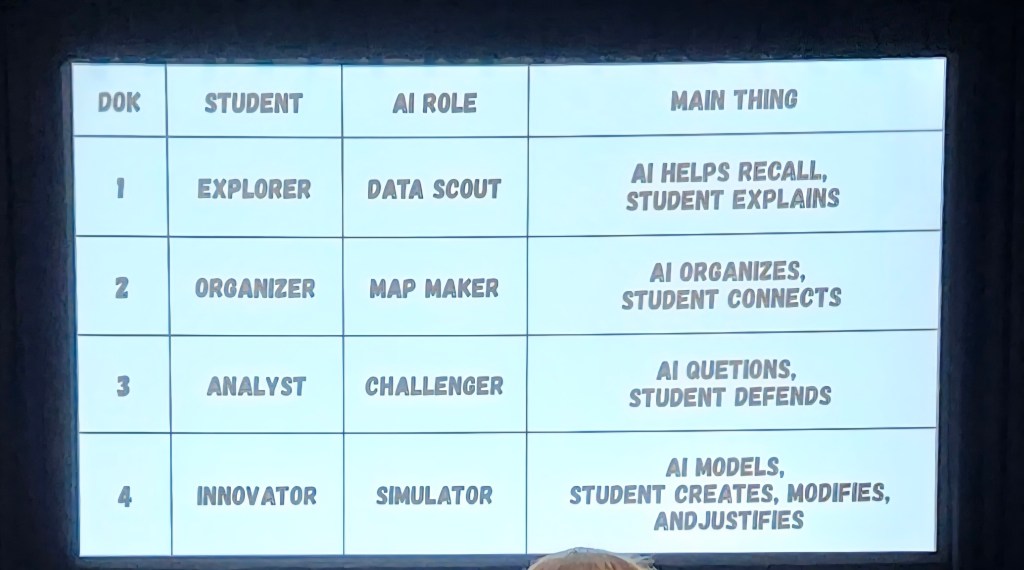
In this model, the student plays the lead role. AI becomes the data scout, map maker, challenger, or simulator. The student explores, organizes, analyzes, and innovates while AI offers structure or intellectual friction. It is a perfect way to ensure that the student is doing the THINKING and that AI is doing the SUPPORTING.
Some suggestions Dr. Mofield gave for helpful prompts for courage are:
Write an argument that disagrees with mine so I can respond.
Give me three perspectives that challenge my view so I can decide which one to address.
A quick courage checklist:
Are students wrestling with ideas rather than receiving them?
Does the task require evidence, reasoning, or revision?
Does AI push the thinking in some way?
Curiosity
Dr. Housand kicked off the next part of the session by telling us that, “Curiosity may not kill the cat after all because satisfaction brings it back.” Our gifted learners are wired to wonder, question, and follow their ideas into unexpected places. Dr. Housand framed this as joyous exploration, the pure desire to seek new information and experience the joy of learning.
AI can either shut curiosity down or open it up. The key is to use AI as a question builder rather than an answering machine. A simple prompt like “Pose five intriguing questions about ____ that do not have simple answers” immediately shifts the task from recall to wonder.
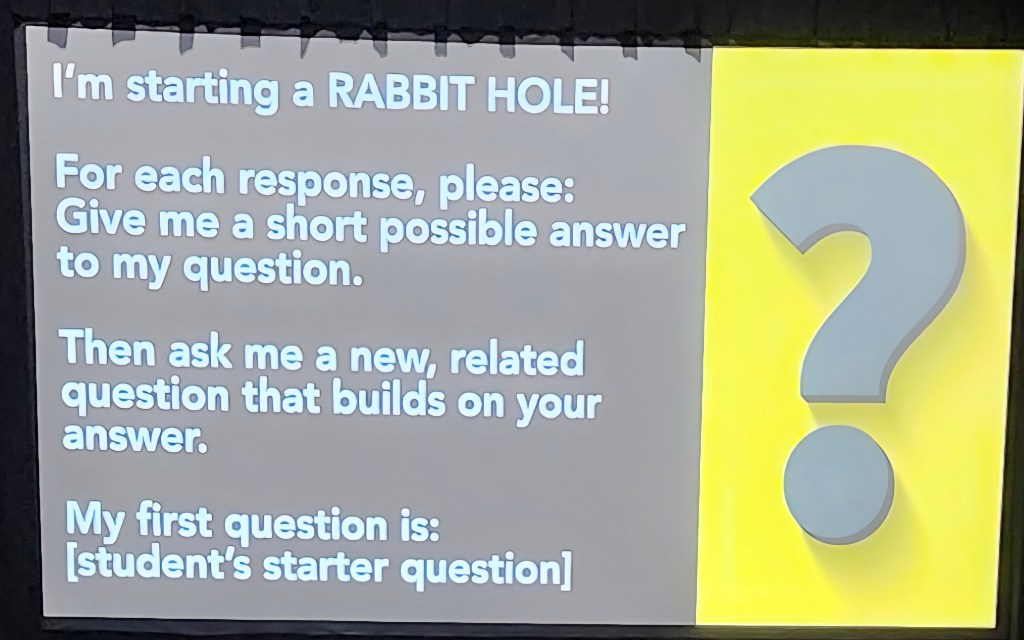
Dr. Housand introduced the “Rabbit Hole OS” inspired by the “5 Whys” questioning technique used by Toyota founder Sakichi Toyoda. This mini-system guides learners deeper into their own questions instead of speeding toward quick answers.
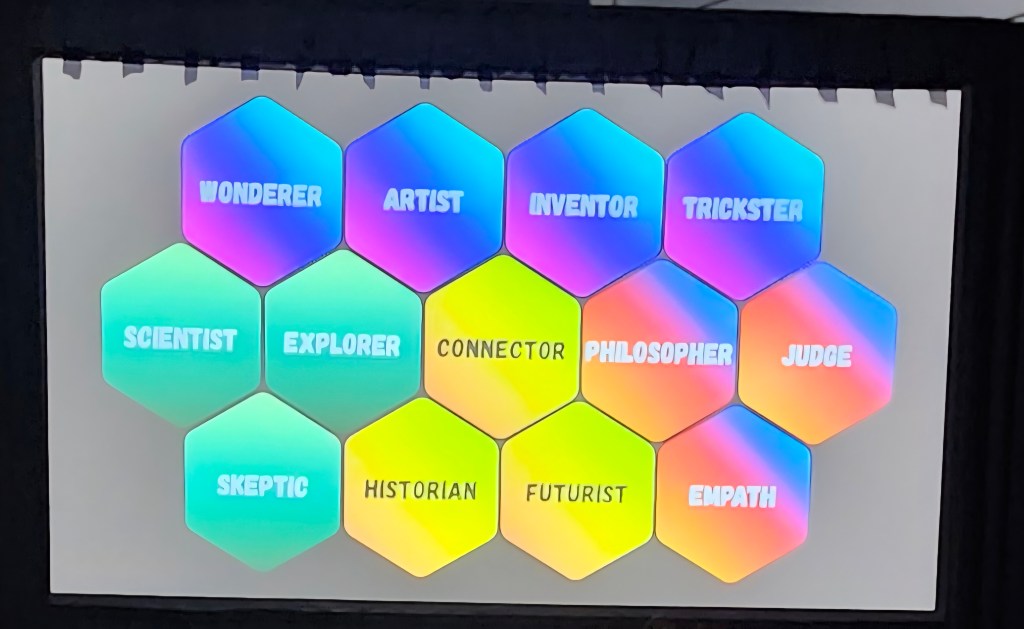
He also shared the Curiosity League, a playful framework with thirteen personas that model creativity, synthesis, discovery, and meaning making. From the Wonderer to the Historian to the Skeptic, students can try on different ways of being curious with AI as a supportive partner. (Sidebar- he has a book about this coming out soon. I can’t wait to get it!)
A curiosity checklist:
Are learners asking questions that lead to discovery?
Are they in the driver’s seat?
Does AI extend their wonderings?
Are students encouraged to follow their curiosity?
Wisdom
One of the hallmarks of gifted education is helping students to build expertise and think like practitioners. Wisdom helps them use metacognition to evaluate their choices, tools, and strategies. Dr. Mofield and Dr. Housand reminded us that teaching is a series of invitations into the hero’s journey. Every academic task is a call to adventure, followed by a test of power, and ultimately a transformation.
They encouraged students to ask reflective questions at each stage:
Call to Adventure
What do I already know?
What is my goal?
What role should AI play?
Test of Power
What new questions does this raise?
What did AI add that I had not considered?
Where do I disagree with AI?
Transformation
How has my learning changed?
What will I do differently next time?
How did AI shape my next steps?
AI can also act as a “Meta Mate” (I love this term!) with prompts like:
Ask me questions that make me reflect on my reasoning.
Help me identify gaps in my argument.
A wisdom checklist:
Are students reflecting on their thinking before, during, and after using AI?
Are they critiquing AI instead of accepting it?
Are they comparing their ideas to AI’s suggestions?
Discernment
Discernment asks three essential questions. Is it true? Is it meaningful? Is it mine? He shared a powerful quote with all of us from the book, Future Shock by Alvin Toffler (note: this is an Amazon Affiliate Link from which I make a small commission): “The illiterate of the twenty-first century will not be those who cannot read and write, but those who cannot learn, unlearn, and relearn.”
This is SO important for us as educators to understand so we can help our students be master discerners. In a world where AI can sound confident even when it is wrong, gifted learners need strong internal filters. To help students practice discernment, Dr. Mofield and Dr. Housand offered a simple process: Wait. Wonder. Weigh. Discernment teaches students to pause before they accept information.
They also encouraged students to explore multiple sides of an issue by generating two opposing persuasive arguments. This helps students notice assumptions, missing information, questionable evidence, and attempts to influence tone.
Helpful reflection questions include:
What assumptions is AI making?
What is being left out?
Who might be persuaded by this viewpoint?
What will I remember the next time I read something from AI?
A discernment checklist:
Are students evaluating information for credibility and bias?
Are they weighing multiple perspectives?
Does the task reward slow, thoughtful reasoning over fast answers?
Is AI being used to challenge assumptions and deepen understanding?
Final Thoughts
I really loved the metaphor of the hero’s journey that was used throughout much of this presentation. As Dr. Mofield and Dr. Housand told us, in every hero’s journey there is always a mentor. In gifted education, that mentor is us! When we teach our students to use AI with courage, curiosity, wisdom, and discernment, we create thinkers who remain unmistakably human. AI may be the sidekick, but our gifted learners are always the superheroes.
So, what do you think about this information? How are you handling AI with your gifted students? What challenges and wins have you had? Please share them in the comments below so we can all learn from each other! ~Ann
At this year’s NAGC conference, I had the chance to attend an excellent session led by Wendy Behrens, M.A.Ed., Gifted Education Specialist for the Minnesota Department of Education, and Ann Lupkowski-Shoplik, Ph.D., Administrator of the Acceleration Institute and Research at the University of Iowa Belin-Blank Center. Their focus was clear: if we want to meet the needs of advanced learners in meaningful and equitable ways, we must think about acceleration not as a last resort, but as a purposeful tool for talent development.
One of the early resources they highlighted is the National Inventors Hall of Fame YouTube channel. It features short documentaries of inductees and is a powerful reminder of what happens when talent is nurtured early and well.
Gifted Education or Talent Development?
Ms. Behrens and Dr. Lupkowski-Shoplik began by addressing an important distinction. Traditional gifted education programs often look for the all-around gifted student, which can unintentionally overlook students with strong and uneven academic profiles. Talent development, however, focuses on nurturing specific strengths. It allows schools to cast a wider net, reach more bright students, and tailor services to areas where a student genuinely needs advanced learning opportunities.
Two Forms of Acceleration
Schools generally think about acceleration in two ways.
Grade-based acceleration, which moves a student ahead one or more grade levels (skipping). Subject-based acceleration, which advances a student in a specific academic area.
Their session focused on subject acceleration, which is ideal for students who show high ability in one or two domains but may not be ready for a full grade skip. Some students may have already been grade skipped, yet still need deeper challenge in a particular area. Subject acceleration gives them access to the right level of content without upending their entire school experience.
Considerations for Acceleration, In General
Let me pause my review for a minute to interject some thoughts about this intervention for highly advanced students. Many people have mixed feelings about acceleration- both whole grade skipping and subject-based (technically, subject-based acceleration is grade skipping, just for one subject instead of the whole grade level). Acceleration is one of the most well-researched areas of gifted education and overall is a successful intervention. Still, in our standards-based teaching reality, it is often hard to grade-skip students. To skip over a whole year of standards in one or more subject areas can create holes in the student’s learning. It takes a very carefully crafted Acceleration Plan to help the parents of the accelerated students know what their child is skipping so that they can fill in the gaps for him or her.
In cases where I support schools that are considering acceleration for a student, I first ask them this simple question that I learned many years ago from Dr. Joyce VanTassel-Baska while earning my Master’s degree and Gifted Endorsement at William & Mary: Is the teacher having to differentiate above-grade level for every single thing being taught? If so, the child might be a candidate for whole-grade acceleration. If this level of differentiation is happening in only one or two subject areas, then the student may be a candidate for subject acceleration. The Iowa Acceleration Scales can help the Acceleration Child Study Team at the school make the best decision for the student in these cases.
For students who need more challenge and differentiation and who are not candidates for whole-grade or subject acceleration, it is likely that one of the other 18 forms of acceleration can help meet their academic needs. The types of acceleration that have worked very well in my school divisions over the years are: compacted curriculum, telescoped curriculum, Advanced Placement courses in high school, Dual Enrollment courses in high school, and graduating early from high school by taking extra classes in the summers. The Acceleration Institute at the Belin-Blank Center has a wealth of information and research about acceleration if you’d like to learn more about this topic. Now, back to my review…
Why Subject Acceleration Works
The presenters described several advantages of subject acceleration.
The classroom teacher does not have to hunt for advanced materials.
Students are more likely to learn alongside intellectual peers.
Students earn credit for the work they complete [if they are accelerated to high school-level courses].
Students stay engaged because they are finally working at the right level.
This approach supports students with uneven academic profiles and helps prevent the boredom, underachievement, and school disengagement that can develop when bright learners sit through repeated content.
What Schools Need to Consider
Successful subject acceleration requires thoughtful planning. Schools should account for scheduling, transportation, credit and placement policies, and long-term trajectories. A student advanced in math today may need access to college-level coursework before high school graduation. These decisions work best when they are made with a long view. Once again, the Acceleration Institute has many resources about acceleration that would be helpful for school divisions.
How Do We Identify Students Who Need Acceleration?
Ms. Behrens emphasized that parent, teacher, or student nomination is not enough. An equitable system includes universal screening and multiple data sources such as:
grade-level achievement tests and subtest patterns
end-of-unit or end-of-year assessments
above grade-level standardized testing two or more years ahead
teacher observation and rating scales
review by a team rather than a single individual
Minnesota uses the statewide MCA tests as one data point, but they are designed as a check on school performance, not student-level readiness. Many states might also have state-level achievement assessments such as these. Schools must look beyond them to build an accurate profile of need.
A Framework for Placement and Planning
The presenters shared a clear procedure for acceleration decision-making that schools can follow.
Review the student’s academic profile.
Evaluate readiness using mastery data and social-emotional considerations.
Collaborate across roles. This includes the gifted specialist, administrators, current teachers, and receiving teachers [the school’s gifted specialist MUST be a part of any team studying acceleration as a student intervention].
Develop a written acceleration plan with goals, instructional settings, and supports.
Monitor progress with formative assessments.
Adjust as needed based on student performance and feedback.
Plan for the long term. Revisit the plan and determine next steps in the talent development pathway.
As I mentioned earlier, many school divisions use the Iowa Acceleration Scales for a thorough, whole-student approach to making decisions about acceleration.
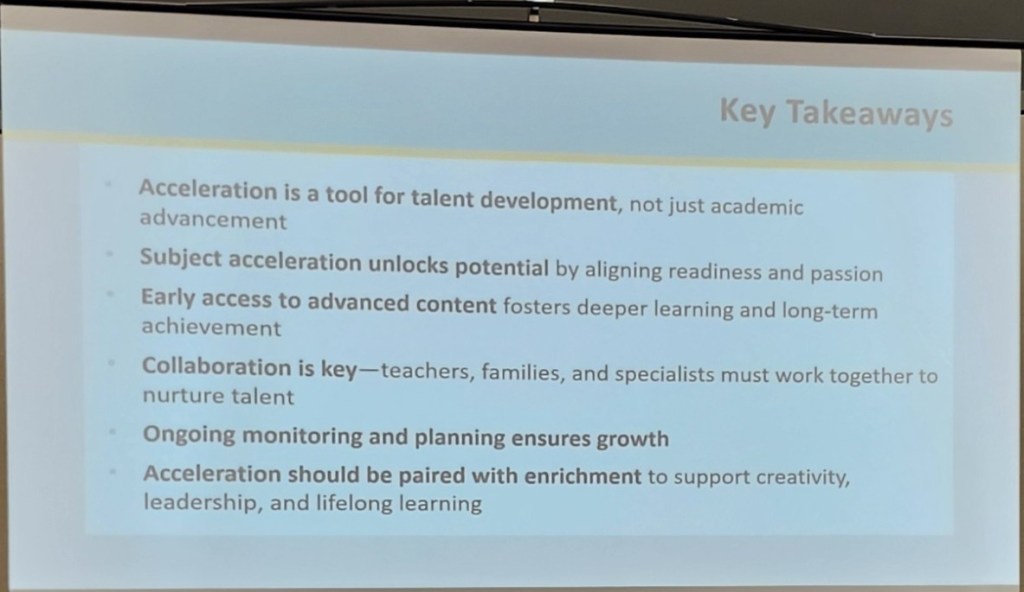
Big Take-Aways for Schools and Families
Acceleration is an important talent development tool.
Subject acceleration aligns instruction with readiness and passion, which unlocks student potential.
Early access to advanced content supports deeper learning and long-term achievement.
Collaboration ensures better experiences for students and teachers.
Acceleration should be paired with enrichment for a balanced program.
Ms. Behrens and Dr. Lupkowski-Shoplik reminded us that subject acceleration represents a flexible and impactful way to meet the needs of advanced learners. When done with intention, it can open the door to meaningful growth for students whose talents are ready for the next step.
Does your school division use subject acceleration, or any of the other forms of acceleration? Share your experiences with acceleration in the comments below. Let’s have a conversation! ~Ann
As educators of gifted and high ability learners, we talk a lot about challenge, potential, and talent development. What we do not talk about nearly enough is motivation. At NAGC25, Dr. Pamela Clinkenbeard delivered a powerful session that blended neuroscience, classic motivation theory, and everyday classroom practice. I was excited to learn from her since the construct of academic intrinsic motivation was important to my dissertation, and she is a motivation expert in the field of gifted education! Her key message was clear: motivation is not something students either have or do not have. It is something we help shape through experience, challenge, and the learning environment we create.
Below is a summary of the big ideas that stood out to me, and how they connect to the work we do supporting gifted learners.
The Brain, Motivation, and Why Challenge Matters
Dr. Clinkenbeard opened with several foundational findings that should guide every gifted educator’s decisions about curriculum and instruction.
First, hard work pays off, especially when a learner is working on something they love at a level that stretches them.
Second, neuroplasticity is real. According to ChatGPT,
“Neuroplasticity is the brain’s ability to change and grow in response to experience. When we learn something new or practice a challenging skill, the brain strengthens existing connections and creates new ones. This means abilities are not fixed. With the right experiences and effort, the brain continues to develop throughout life.”
The brain changes throughout life, and both ability and motivation are influenced by experience. If we do not offer appropriate challenge, we are missing a key opportunity to support talent development.
She shared a helpful acronym: OBDRAC, Optimal Brain Development Requires Appropriate Challenge. Neuroscience shows that without challenging work, the brain misses opportunities to strengthen new pathways. For gifted learners, this is especially critical.
Dr. Clinkenbeard also pointed to research on executive function (EF) training in young children. Early improvement in EF skills slightly correlates with later academic outcomes, particularly in math. The takeaway for gifted programs is simple: high-level challenge and opportunities to think hard benefit learners long before formal identification.
Three Elements That Support Optimal Brain Development
Research continues to affirm three conditions that help students maximize their potential.
Appropriate challenge Gifted students need tasks that bring them to the edge of their thinking. Without it, engagement drops and growth stalls.
A focus on learning and growth instead of performance and competition When students connect learning to curiosity and improvement, motivation strengthens.
Opportunities to invest effort in areas of strength and interest Motivation grows when students spend meaningful time doing work they care about.
For gifted students who often cruise through grade-level content without effort, these conditions become nonnegotiable.
How Psychology and Education View Motivation
Psychology historically viewed motivation as a stable trait. Education tends to treat motivation as a state that can be influenced by the environment. Dr. Clinkenbeard noted that gifted motivation research aligns more closely with the educational perspective. In other words, gifted students are not motivated simply because they are gifted. Their motivation is shaped by the conditions around them.
Classic Motivation Theories and What They Mean for Gifted Learners
Dr. Clinkenbeard walked through five major theories that help us understand motivation in gifted students.
1. Expectancy and Value Theory
Students ask two questions: Can I do this (expectancy)? Do I want to do this (value)?
Gifted students often expect to succeed, but they may not value the task if it feels boring, repetitive, or disconnected from their interests. This is why underachievement sometimes looks like apathy rather than struggle.
2. Intrinsic and Extrinsic Motivation, including Flow
Gifted students tend to show slightly higher intrinsic motivation, but true engagement depends on the right mix of interest and challenge. This is where Mihaly Csikszentmihalyi’s concept of flow comes in (read John Spencer’s great article about Flow Theory; you can also read Csikszentmihalyi’s book from my affiliate link- Flow: The Psychology of Optimal Experience). When challenge meets interest, the self-censoring part of the brain quiets. Jazz improvisation studies offer a vivid example of this effect.
Underachievement research adds another layer. Many formerly underachieving gifted adults credit one caring adult who supported them without judgment. Relationships matter for motivation.
3. Goal Theory and Mindset
Goal theory was a big part of my dissertation, and I always encourage teachers and parents to read Dr. Carol Dweck’s book, Mindset: The New Psychology of Success (this is an affiliate link from which I may earn from Amazon). It was a powerful read for me, and really tied into my findings of math achievement and math motivation of gifted elementary students.
A fixed mindset is when people believe that their intelligence is fixed since birth and cannot really change. The downside of a fixed mindset is that when learning gets tough, students can have imposter syndrome (this is when students worry that others will think they aren’t as smart as once thought because something is hard for them, or students may worry that their success has been due to luck). Thus, the fixed mindset and possible imposter syndrome keeps students from pushing themselves to try hard things.
Dr. Clinkenbeard reminded us that brain malleability exists from pre-birth through old age. A growth mindset (the belief that our ability can grow and change) is not a slogan. It is a neurological reality. “Our brain changes learning, and learning changes our brain!”
Her comparison of two classic profiles was striking:
Satisfied Sam earns average grades but pursues advanced projects independently (this exemplifies a growth mindset, also called mastery goals, since Sam is focused on mastering new learning). Safe Sally earns top grades but avoids challenge to protect her academic image (this exemplifies a fixed mindset, or performance goals, since Sally is concerned with keeping up grades over learning new things that might be challenging).
Which student is underachieving?
4. Self-Regulated Learning
Planning, monitoring, and reflection are essential skills, yet many gifted students underuse them. For students who have rarely struggled, challenges that require self-regulation can feel overwhelming. Productive struggle is not optional. It is how self-regulation develops.
5. Attribution Theory
How students explain success and failure deeply influences motivation. The healthiest attributions are internal and controllable.
Examples: I succeeded because I worked hard (the student is attributing success to hard work) I struggled because I used the wrong strategy (the student is attributing failure to the wrong strategy).
Gifted learners often receive messages about talent rather than effort, and this can distort their explanations for both success and failure.
Bringing Theory Into Practice: The TARGET Model
Dr. Clinkenbeard shared the TARGET model, a practical framework that treats motivation as something educators can influence.
T: Task Challenge, novelty, variety, and enthusiastic presentation matter. Issue for gifted learners: make sure the task is meaningfully differentiated.
A: Authority Give students age-appropriate choices in content, process, and product. Issue for gifted learners: coach them to choose challenge, not comfort.
R: Recognition Use praise and rewards carefully. Focus on improvement. Issue for gifted learners: avoid overpraising talent to prevent imposter syndrome.
G: Grouping Mixed-ability groups can build community, but gifted learners need peers who think at similar levels, too. Issue for gifted learners: avoid using gifted students as classroom tutors.
E: Evaluation Private, criterion-referenced, and centered on growth is better versus norm-referenced testing, when possible. Issue for gifted learners: accountability systems and adaptive tests can complicate differentiation at the high end.
T: Time Adjust pace and workload so students can reach mastery. Offer meaningful extension options. Issue for gifted learners: avoid giving more of the same.
Key Takeaways
Motivation among gifted learners is not a single pattern. It varies across populations and is shaped by experience. Definitions of giftedness also differ widely in research, which makes generalizations tricky.
One last interesting thing that I learned from Dr. Clinkenbeard: Aerobic exercise improves general cognitive functioning more than anything else. I always knew that aerobic activity was good for the heart, but I did not realize how important it was for cognitive functioning, too. Movement matters, so we need to make sure that our students are getting exercise every day!
She also emphasized strong evidence for talent development models grounded in neuroplasticity. Executive function can grow. Self-regulation can improve. Challenge rewires the brain. OBDRAC (Optimal Brain Development Requires Appropriate Challenge) is essential because neurogenesis requires effort.
Final Thoughts
This session reinforced so much of what we know about gifted learners. They need challenge. They need encouragement rooted in growth. They need opportunities to pursue their interests deeply. And they need adults who understand how motivation develops.
If you want to explore further, Dr. Clinkenbeard recommended to us to look into productive struggle research and the work of Siegle and McCoach on motivation.
So, what takeaways do you have from this motivation research? How have you handled instances of fixed mindset in your gifted students? Share your strategies with us in the comments below! ~Ann






 Teaching for Talent