Using multiple criteria (more than one piece of data, such as only ONE IQ TEST) to identify students as gifted is now a best practice in the field of gifted education (thank goodness). So, what are valid criteria that can be used to help schools make decisions about giftedness? I previously mentioned that a nationally-normed and standardized ABILITY test should be one criterion. A nationally-normed and standardized ACHIEVEMENT test is another piece of data that should also be collected for gifted identification. Two clarifications:
Q: Why must these tests be “nationally-normed and standardized?”
A: Tests that are nationally-normed were given to students all across the country when the test was being developed or updated, and those students’ test scores were used to create scoring norms based on ages and grade levels of the students. Tests that are standardized mean that no matter what part of the country (or world) in which a student takes the test, it will be administered in the same exact way and under the same exact conditions described in the testing manual. Theoretically, any given test-taker will receive the test under the same conditions as any other test-taker. Standardized test-giving is a BIG ask, so testing companies require that anyone giving standardized tests have a certain level of training and/or degree to help ensure that the test directions are followed correctly. So, national norming and standardization help educators compare “apples to apples” when using scores from these tests to make gifted identification decisions.
Q: What are ability and achievement tests?
A: Ability tests measure a student’s cognitive ability. Cognitive ability can include constructs such as reasoning, problem solving, memory, etc. These tests are typically timed, and the questions on them can be non-verbal (picture-based), verbal (word-based), and/or quantitative (numerical relationships-based). Achievement tests measure the knowledge that students have learned in school (or through their own learning) in various subject matter areas such as Reading, Mathematics, etc. Both ability and achievement tests produce a score. Test scores are classified as quantitative data. Collecting both scores for gifted identification helps paint a better picture of the student’s academic needs and can highlight any discrepancies that could show potential giftedness (for example, a high ability score but a much lower achievement score shows that the student is not meeting his or her potential academically).
One note- I’m only discussing gifted testing for academic-based gifted programs. There are other types of tests to determine giftedness for arts-based gifted programs or creativity, etc.
As I previously mentioned, quantitative data is only one type of data we should collect on students we are considering for gifted identification. The other type of data is qualitative, but we’ll get into this type in the next installment! In the meantime, what quantitative tests does your school use for gifted identification?
It’s been a while since I’ve posted, and it’s been a longer while since I posted in my Identification Series, so you may need to scroll back to see installments 1-3 from way back when! My last post on identification was about the use of ONE IQ test and a cut-off score. What’s the big deal of using just one test like an IQ/ability test to put students into a gifted program? Plenty, if you were a student like me who got a 128 on the test, but the cut-off to be identified gifted was 130! I mean, seriously, I missed the cut-off by two points! Is there really that much difference between a score of 128 and 130 (NO). Further, maybe that test wasn’t a true indicator of my ability. Maybe I didn’t do my best that test day because I forgot to eat breakfast (unlikely), or my boyfriend broke up with me the night before (much more likely), or I was nervous (extremely likely). Do you see the possible issues with relying on only one timed test to which a cut-off score is applied? Luckily, best practice in education now is to consider the standard error of measure with all standardized test scores, especially when making important programmatic decisions for students (a brief description of standard error of measurement can be found on the Virginia Department of Education website in relation to Virginia Standards of Learning Tests, and a brief explanation of why it’s important to take standard error of measure into account for high-stakes educational decision-making can be found on the Northwest Evaluation Association’s website). Hurray for that! Despite my deep-seated resentment of that 130 cut-off score, I do think it’s important to collect a nationally-normed and standardized ability test score on students going through gifted identification- but only as part of other pieces of data (if you’re wondering what a nationally-normed and standardized ability test is, hang tight… I’ll talk about that next week).
What are your experiences with standardized testing and gifted identification? Have any of you dealt with the dreaded single IQ/ability test and “cut-off” score?
Hello, and Happy Mid-Summer ’24! My Spring and early Summer was crazy-busy (the most exciting parts of it were our oldest son’s wedding and our youngest son’s high school graduation), but I’m super-happy to finally have a little bit of time to blog again.
Teachers, I know you were ready for a break from your jam-packed school year. Parents, I know you were equally ready to spend quality time with your children without having the demands of school schedules to impact your days. But, once we hit 4th of July, we are halfway through summer, and I’m sure 99% of parents are already hearing, “I’m bored!” from their kids, no matter how happy they are that it’s summertime.
So, what are things teachers might recommend to parents to keep their gifted or potentially gifted children THINKING for the rest of the summer? Here are a few of my favorite things that I used to share with parents back when I was a teacher of the gifted, though my ideas are appropriate for ANY child of ANY age. I also added a few newer ideas that I have, as well. (Please note: This article contains a few links to Amazon. As an Amazon Associate, I earn from qualifying purchases.)
Idea #1:
It’s not too late to join the Summer Reading Program at your local library. It goes without saying that an educator would recommend summer reading! 😊 Most public libraries offer so many free summer activities for children from birth through high school. Kids and teens can read to earn prizes, but there are also book clubs, story time, maker spaces, Lego clubs, guest speakers, crafts, movies, etc.- all offered through your public library. Encourage your children to read non-fiction books, too. Non-fiction reading helps to build background knowledge in your children that comes in VERY handy when they are learning new things in school.
Even if your library does not offer any summer programs for children, you can make up your own Family Summer Reading Program! Whatever you do, know that reading to, and with, your child for even a little bit EVERY SINGLE DAY is one of the biggest return-on-investments that you can get for your child’s future educational outcomes (by the way, you can even read to infants!). Reading and talking about what you read together matters. Cost: FREE
Idea #2:
Do a deep dive in an area of interest. To piggyback a little bit from my non-fiction reading suggestion, figure out a topic that your child loves, and do a deep dive into it. When my middle son was at the end of 2nd grade, he became OBSESSED with the Titanic. The first thing we did was go the library and check out as many books about the Titanic as we could find (even adult non-fiction books, which had great pictures with captions). He literally couldn’t focus on much else for a few months. He read and looked at pictures about the Titanic, he watched documentaries about the Titanic (this time period was the dawn of Netflix streaming!), and he built his own Lego ship model of the Titanic. We took it even one step further one night and had Titanic Night for dinner. I made a fancy meal, we dressed up, we used fancy china dishes that we set in our dining room instead of the eat-in kitchen, and we dimmed the lights and lit candles. We pretended we were rich passengers on the Titanic, eating dinner. It was so much fun! There were a ton of other things we could have probably done along this theme, of course, but what we settled on was so much fun!
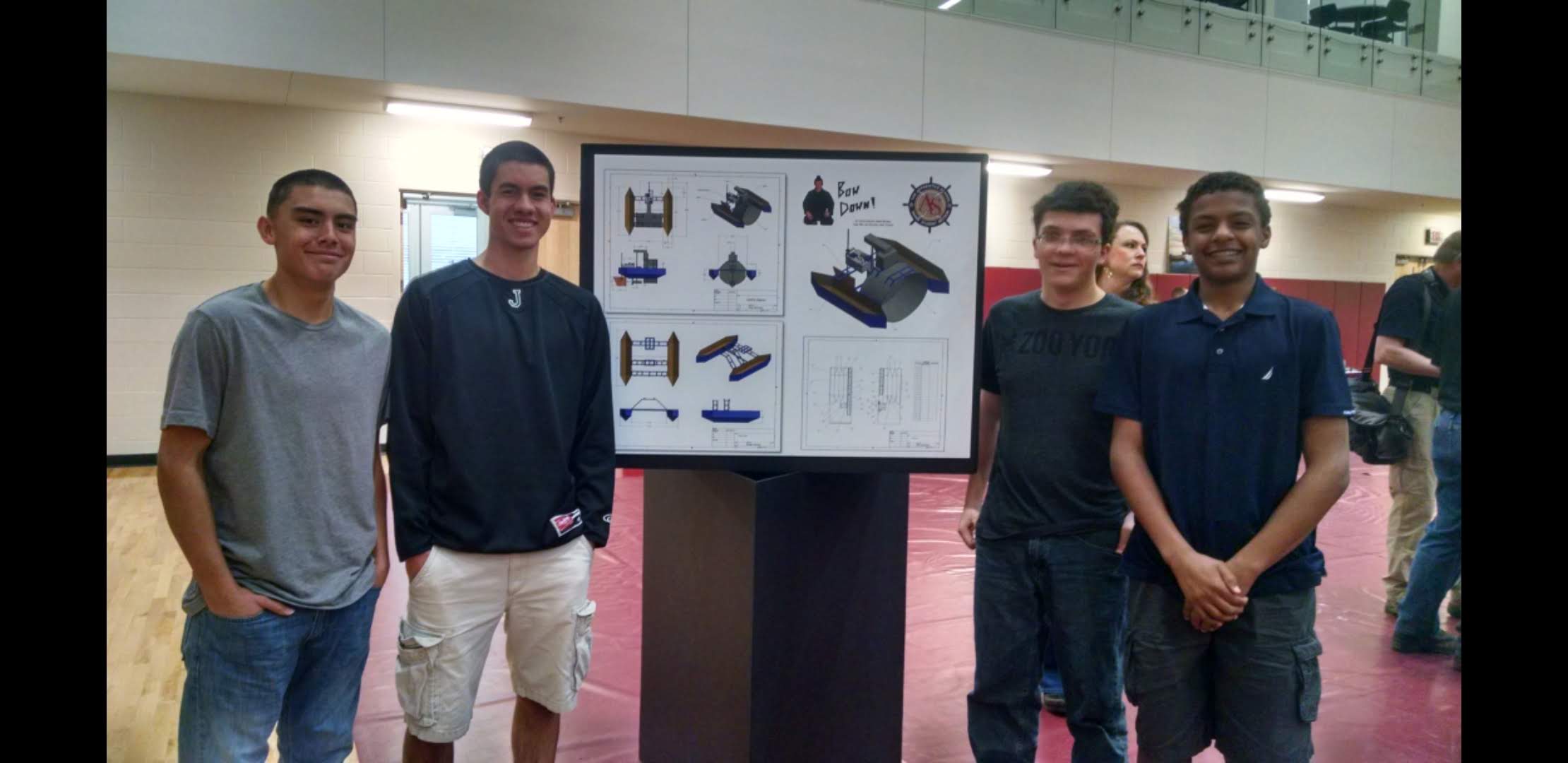
These deep “obsessions” with topics that young children have are often a manifestation of an academic strength area for children. For my son, his “study” of the Titanic at age 8 lead to a deep interest into World War II ships in the summer going into 8th grade (thank goodness for Netflix streaming again!). He spent that summer constructing models out of old aluminum siding strips from Grandpa Colorado’s garage, duct tape, and rivets using my husband’s riveter tool. Then, he would test their ability to float in his bathtub (he also dabbled in WWII plane construction, too). He had a little notebook of ideas that he kept with his designs. Once he got into high school, he took a CAD class (Computer Aided Design) and learned how to use that software to design things like boats. Through that class, he was part of a team competition on boat design for our whole region of schools. He ended up attending one of our country’s five federal service academies. Guess what his major was? Marine Engineering! Guess what he does now? He’s a Marine Engineer! It wasn’t the least bit surprising to my husband or me that this was his career choice. I’m not saying that every child’s early interests will lead to a career (I have the benefit of hindsight from which to draw the connections for my son). I AM saying that we should pay attention to (notice) and do something about (nurture) our children’s passion areas when it’s possible. Cost: FREE (other than scavenged scraps of materials and Netflix subscription costs)
Idea #3:
Play some good, old-fashioned board games– and some online games, too. Board games may seem hard to fit into family time during the school year, but summertime gives us a little more grace. Keep track of wins & losses all summer and you have yourself your own Family Tournament! Some of the board games I always recommended to parents to play with their kids were strategy games, such as:
Chess– The ultimate strategy game! I first taught my boys chess when they were in 1st grade.
Apples to Apples- Excellent for learning vocabulary and mastering the art of persuasion. The game comes in a junior level and an adult level, ages 12 and up.
Scrabble and Bananagrams– Vocabulary-building, spelling, and strategy game- all in one!
Set Game– Logic at its finest, and there is an online version of this game, too called “Daily SET Puzzle.”
Monopoly– Love it or hate it (it’s so LONG!), it is great for practicing money skills and gaining a foundational understanding of how real estate works.
Rush Hour- A fun spatial-relation building game that has varying levels of challenge at the junior level and ages 8+ level.
Jigsaw Puzzles- Building a regular puzzle on the dining room table also builds spatial-relation skills. There are also great online puzzles you can play each day for free through the New York Times if you make a free account (Soduku, Wordle, Mini Crosswords, Connections, and Strands).
Playing board games together as a family not only develops your child’s strategic thinking ability and skills, but it also deepens your family bond. (If you don’t already have these games, but would like to purchase them, please see my Amazon Affiliate page on Pinterest.) Cost: Free if you already own the games or borrow them
Idea #4:
Go on Family Field Trips. To me, ANY excursion out of the house can be turned into a field trip! 😊 A field trip just means going somewhere for an educational purpose, to observe or do something first-hand, in-person. You honestly could turn your weekly grocery run into a field trip if you include the right elements! Here is a brief example of how to do this:
Element #1: A purpose (to plan the best meals for our family this week using a $100 budget).
Element #2: Background knowledge (watch YouTube videos, talk to different people, read an article together, etc. to learn the best ways to plan meals and use a budget).
Element #3: Choose your destination that will serve the PURPOSE and USE the background knowledge gained (go online and find all of the grocery stores near you and maybe pick a new one to “explore” with your kids for this excursion).
Element #4: Go to the place you picked (go there, do the shopping and price comparison, buy everything, bring it home, and put it away; you could even talk to some of the managers or other grocery store workers in each department to learn about what they do).
Element #5: Process and apply the experience gained from the field trip (talk through what you all learned and make the specific plans to prepare the meals with the food you bought on your field trip).
Element #6: Share what was learned from the field trip (in this case, through the meals your children helped plan, shop for, and maybe even cook!).
Walla! You have a relatively instant field trip that you could throw together in 30 minutes. You could use those 6 elements for so many other family excursions, too!
Cost: Variable, depending on where your field trips are and if you buy anything there
Idea #5:
Create a small business. I know, you’re probably thinking that I’m crazy- my kid is only 12 years old, or 5 years old, or really, just a KID. However, think back to your own childhood. I bet that you- or someone you knew- or a cousin of someone you knew- had a lemonade stand in front their house at least once each summer. THAT is a small business! The sky is the limit now-a-days with the types of businesses kids can start and run, especially using the power of the internet. Why not spend time helping your child figure out what he or she might be able to make and sell or provide a service to sell. Dog walking? Bracelet making? Babysitting? Drawing portraits? Lawn mowing? The possibilities are endless.
While you’re at it, it wouldn’t hurt to help your child to start thinking about financial independence (FI). Quite honestly, our schools are not able to teach students everything that they need to know to access and leverage our economic system. Why not help them at home? A great place to start is with free Pre-K-Grade 12 Financial Literacy curriculum available from the ChooseFI International Foundation. There are also really good books out there that you could read together with your older child. One I particularly liked was, First to a Million: A Teenager’s Guide to Achieving Early Financial Independence, by Dan Sheeks. He also created a companion workbook for teens to use called, First to a Million Workbook: A Companion Guide for Teens to Achieve Early Financial Independence. I read the book, then I gave it to our youngest son for Christmas a few years back. The author also has a robust online community to support teenagers on their journey to FI. Cost: Variable, depending on book purchases and supplies for business start-up costs
Idea #6:
Give your child Incubation Time each day. Okay, I’m sure you are wondering what on Earth is “Incubation Time.” In the creativity research, incubation time is time to do NOTHING BUT THINK AND DAYDREAM. This is a really novel idea in the 2020’s (and even further back, if we are being honest). In our pursuit to give our children all of the experiences and things we feel are necessary to set them up for a successful life, we have inadvertently over-scheduled them (and, I’m not pointing fingers because I was quite guilty of this, too, when my three boys were younger). People, especially kids, need time to do nothing each day. When we have downtime with nothing scheduled, our brain has a chance to actually process things we’ve learned and experienced. When that happens, all of a sudden our brain is able to solve problems that we might have been stuck on or think of new ideas that we never thought of. Downtime is not a waste of time at all- it’s an opportunity for creativity to emerge!
Just to drive home my point a little deeper, I believe that we are all familiar with the concept of downtime. However, as adults, we just have been using it differently- as “veg-out” time. We spend that time scrolling social media or binging Game of Thrones (guilty again 😊). There is a time and a place for veg-out downtime, but please don’t use it to REPLACE incubation downtime, especially for our children.
If you’d like to learn more about Incubation Time and what to do with the ideas that might spring forth from it from your children, there are books available that teachers use. In schools, many teachers tap into this concept of Incubation Time through the use of Genius Hour or Passion Projects. Here a book that I have used to help teachers design Genius Hours in their classrooms, but parents could certainly use it, too: Ready-to-Use Resources for Genius Hour in the Classroom: Taking Passion Projects to the Next Level, by Andi McNair.
I think it would be fairly easy to run Genius Hour in your home during summer break. Cost: FREE, barring the costs for passion project materials that spring out of Incubation Time and if you purchase a Genius Hour book
So, there you have it. Six ideas that cost relatively little to implement and use but pay enormous dividends in family fun and keeping kids’ thinking skills and creativity skills sharp all summer long.
Do any of these ideas resonate with you? What ideas do you have for keeping your gifted child challenged and thinking during the rest of the summer? Please leave a comment for us and post your pictures of family enrichment here. I can’t wait to hear from you! Enjoy the rest of summer! ~Ann
It’s been a while since I posted about gifted identification because I’ve been so wrapped up in trying to share all the things I learned from attending NAGC last November (and I’ve attended TWO MORE gifted conferences since then)! However, in my world as a Coordinator for Gifted Education, we are in gifted testing season right now, and I’m sure many other school divisions around the country are, too. So, it seems like a good time for me to get back to my gifted identification series. Please scroll back to read Posts 1 and 2 about gifted identification if you’d like to get up-to-speed.
In Blog Post #2 of the gifted identification series, I told the story of how the archaic practice of using an IQ cut-off score effectively cut me out of the gifted program in my high school. The IQ- intelligence quotient- cut-off score was infamous in gifted education virtually everywhere for most of time until probably the 1990’s when gifted researchers and educators began to rethink the reliance on timed IQ tests (fact: many school divisions all across the country STILL use IQ cut-off scores to identify gifted students). Using only an IQ score to identify students as gifted is an example of the “nature” or “entity” philosophy of giftedness- people are either born gifted, or they aren’t- and the belief that the use of one test score can tell us that. IQ scores have a rich history and do serve a purpose (mainly by giving educators an indication of students’ cognitive ability), but there are many more ways to find gifted students other than using one test score. So, why did schools ever use a cut-off score, then? Because in the past, most educators had an entity mindset about gifted. Plus, how easy was that? Give all the kids a test, and the ones who scored 130 or higher automatically got into the gifted program! What’s so wrong about that? Let’s explore that question next time. In the meantime, you can read a one-pager from Davison Institute about IQ and the Bell Curve for fun!
What experiences do you have with using an IQ cut-off score with gifted identification? Please share so we can learn!
Dr. Donna Y. Ford is the gifted research guru in the issue of underrepresentation of students of color in gifted and advanced programs. The title of her NAGC23 talk last November was quite appropriate. Though educators and experts in the field of gifted education have been working on this issue for 30+ years- hardly anything has changed! We still see fewer students from underrepresented populations in our gifted programs, our AP classes, etc. We also still see OVERrepresentation of these students in special education programs and in discipline numbers. So, what are we to do? Dr. Ford discussed her “Dirty Dozen” for us to combat. Here are my notes to the best of my ability from what I remember!
Donna Ford’s Dirty Dozen
Issues Caused by Deficit Thinking
According to Zaretta Hammond, deficit thinking means holding beliefs, attitudes, and values that define students by their weaknesses instead of their strengths. Deficit thinking leads to:
Low and negative expectations
Stereotypes
Racism
Under-referrals- All of the above contribute to teacher under-referral of students of color to gifted testing.
Issues Caused by Instrumentation
5. Bias
6. Unfair and Inequitable
7. Inadequate norming (not using Local Norms when appropriate)
8. High Stakes nature
Instruments contribute to underrepresentation in gifted programs. Dr. Ford asked the question: If a particular group keeps doing poorly on a test, why do we keep using it? She said that non-verbal measures are better to use for gifted testing since they reduce the cultural loading we see with traditional tests. She also described the assumptions that are built-in to traditional testing that make them unfair and inequitable, such as:
Homogeneity in life;
Cultural differences don’t matter;
What interesting in one culture is interesting in another culture;
Everyone had an equal opportunity to learn before taking the test;
Tests are neutral, objective tools; and
Everyone is familiar with paper-pencil tests.
Issues Caused by Policies and Procedures
9. Norms and Cut-offs
10. Approved tests
11. When students are assessed
12. New referrals
We are still utilizing policies and procedures for gifted testing that lead to underrepresentation in gifted programs. We need to audit our policies and procedures to ensure that we are using culturally fair testing, using local norms (when appropriate), getting away from cut-offs, creating better assessment windows, and opening up our referral processes so parents and community members know about them.
Dr. Ford also discussed the Office of Civil Rights’ (OCR) 80% Rule- that there was a court case that gives school divisions a 20% allowance for their gifted identification numbers. In her work, she has called this the “Equity Index.” What this means is that our identified gifted student subgroups should be within 20% of the actual subgroup student population for each school or school division. She has a terrific article describing this concept and how to figure out your Equity Index for your own school. You can download the article here:
Lastly, Dr. Ford finished up her talk by telling us that CULTURE MATTERS! Culture is learned and acquired, so we should not ignore it. Zaretta Hammond talks about how the brain is our hardware, but culture is our software. Dr. Ford also gave us the metaphor of the iceberg- Culture is like an iceberg (watch this quick YouTube video to learn more).
Along the culture lines, she shared with us Boykin’s Afro-Centric Cultural Styles Model. Through my research for this blog post, I found a really interesting short article written by Ford and Scott which does describe Boykin’s model- Under-Representation of African American Students in Gifted Education: Nine Theories and Frameworks for Information, Understanding, and Change (2010). It has been over 13 years since this article was published. After reading the article, the first thought that came to my mind was, “Wow! I agree with Dr. Ford. The more things change, the more they stay the same!”
All of the things I heard from Dr. Ford really resonated with me and made me do a mental audit of the policies and procedures we have for gifted identification in my school division. Though I feel we have done much in my division over the past few years to create a more equitable gifted identification system (for example, using the standard error of measure when considering standardized achievement test scores, considering extenuating circumstances of students, adding alternative data to supplement the gifted data, pushing in to classrooms to work with all students through Talent Development lessons, training teachers, etc.), there is always more to do. Dr. Ford’s talk gave me great momentum to make sure my school division is doing the best we can to find gifted and potentially students of all populations.
What resonates with you from my notes? What things are your school division doing to create a more equitable gifted identification system for students?
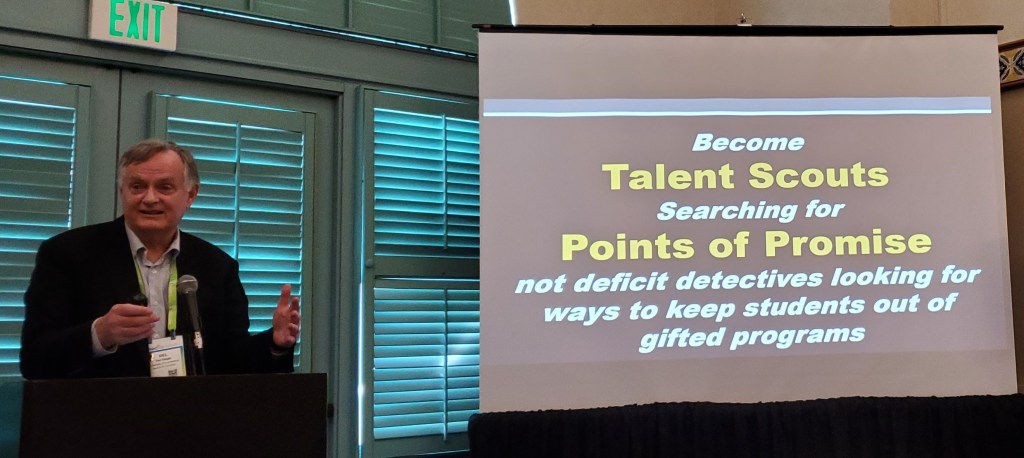
Another informative session I attended at NAGC last November was by Dr. Del Siegle and Dr. Betsy McCoach called, “Research to Guide Practice: Findings from the National Research Center That Practitioners Need to Know” (11/10/23).
Drs. Siegle and McCoach are two of the heavy hitters in the field of gifted education. They shared a plethora of research over the years from the National Research Center for gifted education that is housed at the University of Connecticut, where they both are professors. Here are some of the big take-aways based on NRC research that I had…
Underrepresented Populations in Gifted Programs, In General
What works based on the research?
Conduct universal screening AND consider achievement data [not just ability data] to address this gap in identification.
Address achievement gaps early since 3rd grade academics accounts for much of the under-identification we see.
Since NO combination of cognitive ability scores, achievement scores, and teacher ratings completely addresses the equity issues we have, we can:
Use local norms if we have homogenously populated schools (does not work with economically balanced schools)
Use “OR” instead of “AND” to expand criteria
Provide yearly training on teacher rating scales since there is so much variability between teacher ratings.
Successful English Learner Gifted Identification
What works based on the research?
Universal screening
Alternative pathways for identification
Establish a web of communication with home and school
View Professional Development as a lever for change (side note- it warmed my heart to hear them share this tip since I firmly believe it)
Screen EL students for gifted if they move quickly through the EL program.
Other Interesting Research Findings
Requiring differentiation is important since it is critical for every student (YES!).
Allow some teacher autonomy to adjust pacing guides as needed for their students.
Gifted services MUST align to gifted identification (Determine program outcomes > Design program > Design ID for the program)
Are there benefits of gifted programs beyond achievement? One study about gifted boys- they typically go to college, take more AP courses, graduate on time, and have higher high school math GPAs.
Overall, it was very interesting to me to learn about these practical, research-based suggestions for increasing diversity in our gifted programs. Does your school division use any of these tips?
My first session after the keynote was about fathers’ influence on their gifted sons by Thomas P. Hébert, Ph.D. out of the University of South Carolina. You may be thinking, “You’re a woman, and you’re definitely NOT a dad! Why on earth did you attend this session?” Well, I’m a MOM of 3 sons with a husband who IS their DAD, plus I’m an administrator over a gifted program that is roughly 50% male, so… I thought I could learn something to share with my teachers and with parents in our school division! And, wow, I certainly did!
Dr. Hébert’s research centered (and now centers, for his current study) on the over-arching question, “What factors in father-son relationships influence the talent development of high-achieving males?” He did make it clear to the audience that his body of work was qualitative using a very small sample size (10 college-age male gifted students), so we cannot generalize from his research. However, the findings from his interviews revealed some very interesting themes that I have taken as food for thought:
Father’s strong work ethic and self-sacrifice.
Father as teacher of skills and life lessons.
Father’s design and maintenance of father-son rituals (bonding time).
Father’s quiet presence on the sidelines (whether sports or academic competitions).
Father’s authenticity and comfort with himself (down-to-earth).
Father’s respect for his son’s talents, decision-making, and developing independence (actually, there was a mutual respect and admiration between father and son).
Father’s pride in his son.
Though Dr. Hébert told us not to generalize to our populations from his findings, he did give us a call to action to take note of these themes and see what we can learn from them. What I learned was that none of these themes really cost any money- they are mostly about showing up and supporting their sons (of course, sports and academic competitions could cost money and so could the bonding time if there was a trip involved with that or something). I also had several ponderings after seeing these themes: Would the same themes emerge with Moms and Sons? Dads and Daughters? Moms and Daughters? Can we really say YET if these themes influence talent development or are just CORRELATED with it? Really great food for thought!
All in all, I think it’s important for dads AND moms to be aware of these themes and consider them in how they show up for their children, whether they happen to be boys or girls. Doing these things are truly what I consider good parenting, anyway. What do you think about Dr. Hébert’s findings?
The opening Keynote Address for my very first ever National Association of Gifted Children Annual Convention was nothing short of AMAZING! The speaker was George Couros. According to the NAGC website…
George Couros is a worldwide leader in the area of innovative teaching, learning, and leading, and has a focus on innovation as a human endeavor. Most importantly, he is a proud father and husband. His belief that meaningful change happens when you first connect to people’s hearts, is modeled in his writing and speaking. In his 20-plus years in the field of education, he has worked at all levels of school, from K-12 as a teacher, technology facilitator, and school and district administrator, and is currently an Adjunct Instructor with the Graduate School of Education at the University of Pennsylvania. George is also the author of the books, The Innovator’s Mindset: Empower Learning, Unleash Talent, and Lead a Culture of Creativity, Innovate Inside the Box, and his latest release, Because of a Teacher and Because of a Teacher 2. Learn more and follow George at his website.
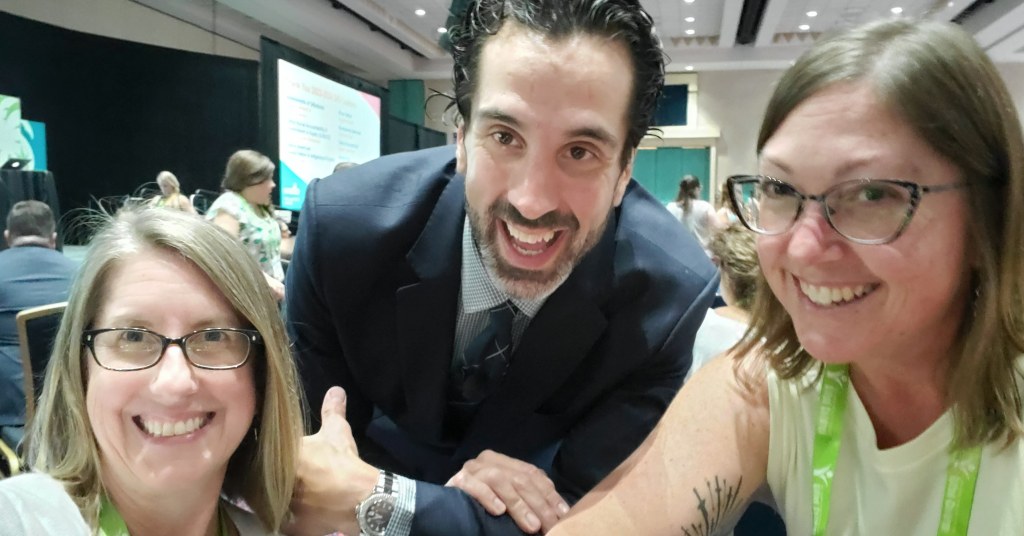
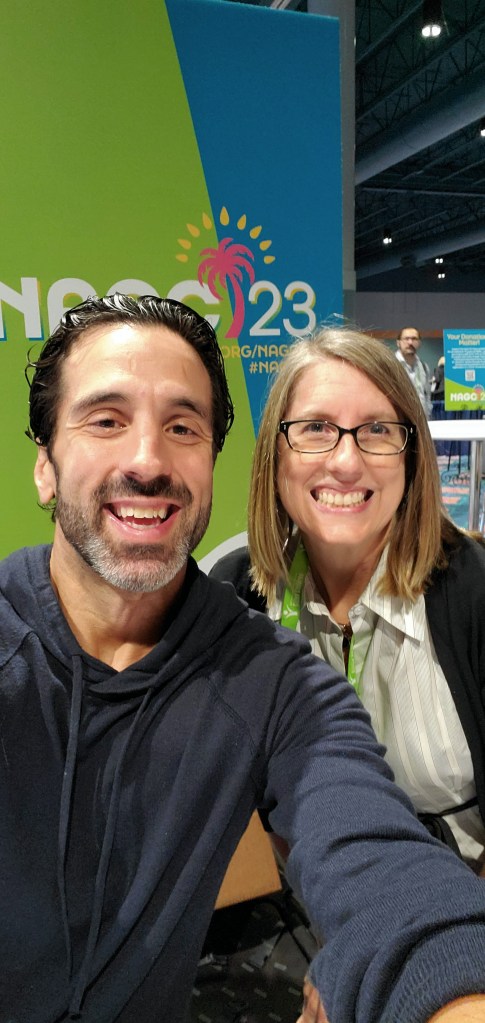
Here is George working the crowd before he begins! He stopped by my teacher’s and my table to meet us!
He was smart, relevant, and really funny! His PowerPoint was terrific- very streamlined with great photos. Moreover, his message was powerful. George taught us (in a nutshell) about the Innovator’s Mindset, which is the belief that abilities, intelligence, and talents are developed so that they lead to the creation of new and better ideas. There are the eight characteristics that make up this mindset. An innovator is: reflective, empathetic, a problem-finder/solver, a risk taker, networked, observant, a creator, and resilient.
He gave us different examples of what these characteristics might look like in the classroom or in our community. Here is one example I LOVED about a problem finder (watch this cool little TED Talk from a teenager, Maanasa Mendu, who noticed a problem and is actively solving it).
Here are my TOP THREE take-aways from George’s talk and what they made me ponder:
#1: “Would you want to spend the whole day learning in your own classroom?”
Wow- this question is a real eye-opener! Though I am no longer in the K-12 classroom, I am often teaching educators and administrators. So, I find this question completely still relevant to me. As a former teacher of 5th graders, I do believe that students wanted to spend their whole day learning with me (I’m basing this on the amount of times kids would ask me if they could eat lunch in my room or hang out in my room during their recess time). However, I want to keep this question close at hand as I design the next course I’m teaching to teachers this semester. I want to make sure to balance the content with meaningful processing activities, personal connections, and some easy take-aways that teachers could immediately use.
#2: “When you have a compelling reason, you can learn anything!”
I could not agree with this quote from George more. Kids (and adults) need a reason to learn. My son used to lament to me quite frequently, “My teacher said we had to learn this for the test. I don’t care about the test or this class!” Nothing strikes up de-motivation in a student faster than telling them they must learn it FOR THE TEST!
Having a reason to learn reminds me of Marzano and Pickering’s 4 emblematic questions about student engagement from their book, The Highly Engaged Classroom (as a side note, I did a whole-year Professional Development series on this book with two different school staffs…):
How do I feel?
Am I interested?
Is this important?
Can I do this?
The questions “Am I interested?” and “Is this important?” directly relate to giving students a reason to learn something. We know there are things that we are obligated to teach students according to state or federal mandates. However, if we can frame our content in a way that connects somehow to what interests our students and/or what is important to our students, then students will learn better and will achieve better outcomes. There are many FREE reproducible resources at Marzano’s website.
#3: “Change is an opportunity to do something amazing.”
Heraclitus said, “There is nothing permanent except change.” How many people do you know who hate change, who actively loathe it and resist it, especially change in education? A lot, right? We as educators must adopt a different mindset about change. If we take George’s words and think of change as an OPPORTUNITY to do new and cool things and not as a burden, then we will be much happier teachers and our students will be much more engaged learners.
Let me leave you with my FINAL THOUGHT on the Innovator’s Mindset: teachers have so much power to help nurture our students to do amazing things! We have the power to develop all of our students’ abilities, intelligence, and talents. We can leverage change as an opportunity to try something new with our students and give them the chance to really show us what they know and are able to do. We can find the innovator’s characteristics inside of ourselves to impact our students. Have fun innovating!
If you want more content about and by George, you can connect with him through his social media accounts:
Twitter and Instagram: @gcouros
Facebook: facebook.com/georgecourosauthor
YouTube: @georgecourosim
He also has written several books, one of which I bought and he signed (The Innovator’s Mindset)!
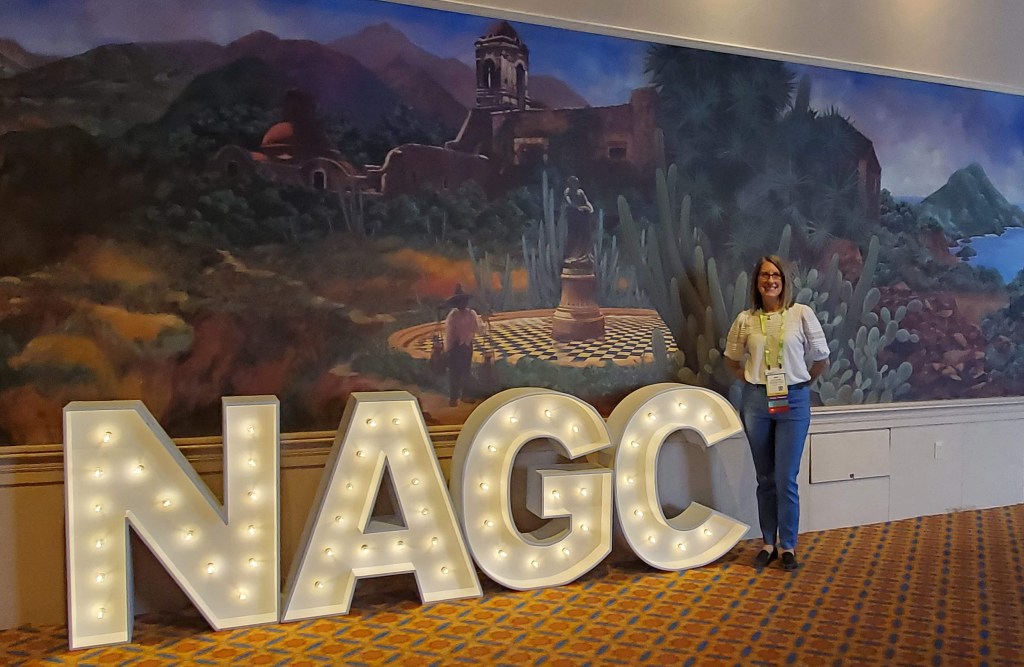
Wow! It’s taken me two weeks, but I am finally settled down from the totally HYPE National Association for Gifted Children’s Annual Convention that was held November 9th-12th in Orlando, Florida. I must confess that though I have been in gifted education for 28 years, I HAVE NEVER BEEN TO AN NAGC ANNUAL CONVENTION! If you have never gone, I highly recommend you try to attend in Seattle next year! Trust me- you’ll love it and learn so much!
From the opening keynote (George Couros talking about “The Innovator’s Mindset”) to the closing keynote (Donovan Taylor Hall speaking about “The Learner Inside: Creating Emotional Safety in Learning”), the learning for me never stopped. I felt like I was among celebrities all weekend, which actually, I was, if you think about it. I got to listen to the giants in the field of gifted education talk about the things they wrote WHOLE TEXTBOOKS ABOUT way back when I was getting my Master’s degree with an endorsement in gifted education in the early 1990’s. I got to hear Dr. Joyce VanTassel-Baska (my former professor at The College of William and Mary, by the way), Dr. Del Siegle, Dr. Betsy McCoach, Dr. Donna Y. Ford, Dr. Ann Robinson, Dr. Nicholas Colangelo, and Dr. Rena Subotnik. I also learned from many other educators during the four days of the convention, including Dr. Tamra Stambaugh and Dr. Catherine Little, fellow W&M alumnae!
In order to best process my learning and share it with teachers and coordinators, I’ll be writing a series of blogs from the sessions I attended at NAGC (16 total, including the presentation I gave and the poster I presented). I can’t wait to share what I’ve learned with you! Please leave me a note in the comments if you’ve ever attended an NAGC Annual Convention. If so, when and where did you attend and what is one big take-away you had from it to this day? I hope to learn about some great take-aways from you! ~Ann
Let’s take a little trip down memory lane, early winter of 1986. It was time to register for my classes for senior year. I had looked through the list of class offerings and chose a “Mentorship in Law” class for one of my electives. This class would be perfect for me since I thought I wanted to be a lawyer (spoiler alert- I didn’t become a lawyer). Within seconds of handing my Guidance Counselor my course request list, she informed me that only gifted students were allowed to take the mentorship class. I, as a matter of fact, was not a gifted student. So, I told her I wanted to take that class, and then referred myself for gifted testing. She gave me a handful of papers and sent me on my way. I only remember three things from my gifted testing experience from back in 11th grade:
my parents’ response(s) on the questionnaire about their observations of me at home (we’ll tuck this story away for another time);
the timed IQ test I had to take; and
the results of the testing.
The results of the test finally came, and you can imagine my disappointment when I read that I received a 128 on the test, but the cut-off to get identified gifted was 130. Needless to say, I did not get to take the “Mentorship in Law” class my senior year due to this dinosaur of a practice in the field of gifted education. It would be many years before I got justice for this disappointment of testing, but I did eventually redeem that score (that’s a story for another time).
Have you ever had a situation where high-stakes testing impacted your life in some way? I’d love to hear about it! ~Ann







 Teaching for Talent