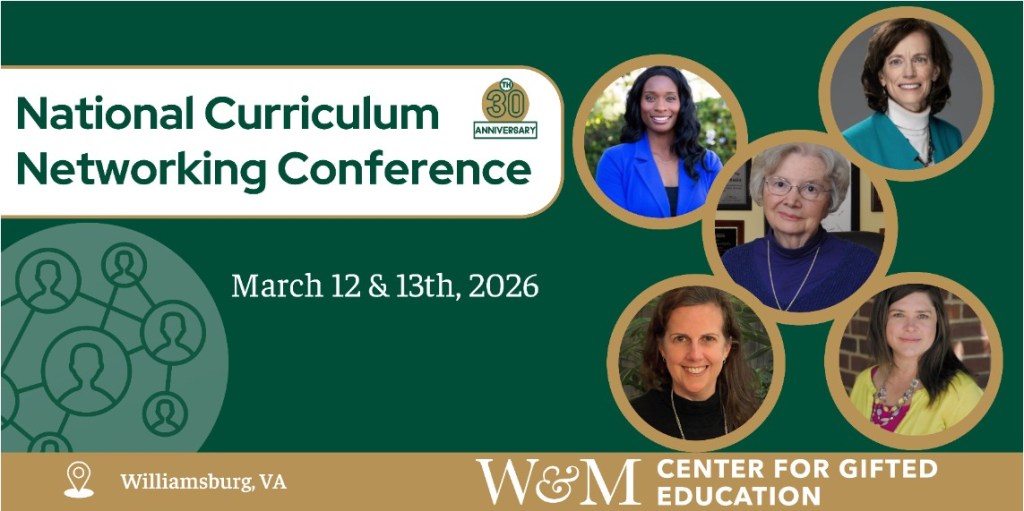
Good morning! I’m very excited to announce that I will be presenting a session at the National Curriculum Network Conference at the W&M Center for Gifted Education on March 12, 2026! What is the NCNC? According to the NCNC website:
The Center for Gifted Education’s annual National Curriculum Networking Conference (NCNC) offers sessions on curriculum, instruction, programming, assessment, and advocacy for high-ability and gifted learners. NCNC also provides opportunities for networking and highlights of the newest materials, practices, and curriculum approaches that are responsive to the needs of advanced students.
My session, The Power of We: A Step-by-Step Guide to Gifted Program Planning with Stakeholders, is designed to help gifted coordinators, school leaders, and other gifted educators tap into stakeholder feedback, ideas, and support when planning for a variety of gifted programming. See the session description for more details.
If you are a gifted educator and will be anywhere near Williamsburg, Virginia on March 12th-13th, I highly recommend you attend this historically amazing gifted conference, especially because the Center for Gifted Education (CFGE) will be celebrating the 30th anniversary of the conference! Even more exciting, Dr. Joyce VanTassel-Baska, world-renowned gifted expert and the original Executive Director of the CFGE, will be at the conference on the 12th! If you come to the conference, please reach out and say, “Hi!” to me! ~Ann
I hope you were able to take away some helpful ideas and strategies to improve the identification of students from underrepresented populations from this mini-series. It was helpful for me to write it because it solidified the concepts I shared in my mind! Let’s briefly review the content I shared…
Looking Across the Research
When viewed together, the scholars highlighted in this series offer a cohesive vision for equity in gifted education. While their areas of focus differ, their messages align around access, opportunity, and responsibility.
Shared Themes
Across these contributions, several consistent themes emerge:
Broad and inclusive definitions of giftedness.
Strength-based and culturally responsive identification.
Rigorous curriculum that affirms student identity.
Leadership and advocacy grounded in equity
Moving Forward
Equity in gifted education is not achieved through isolated strategies. It requires sustained reflection, professional learning, collaboration, and a willingness to examine long-standing assumptions.
In Sum
Equity is not an initiative or a checklist. It is a mindset, a commitment, and an ongoing practice. There are tangible strategies to apply to gifted identification systems that will make a measurable impact in identification results.
Your Turn
Which ideas from this mini-series will most influence your thinking or practice moving forward? Share your reflections below and let’s keep the conversation going! ~Ann
From the Arizona Alliance of Black School Educators Website
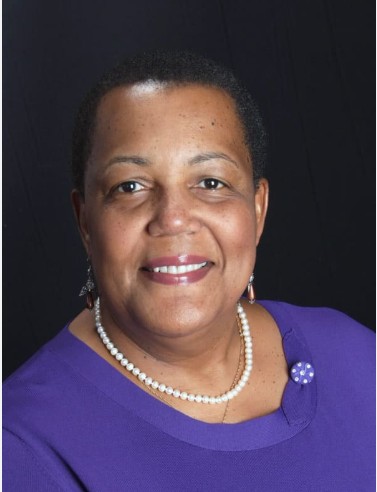
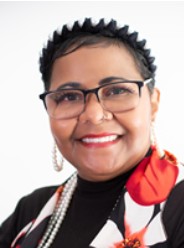
Dr. Joy Lawson Davis is a nationally recognized leader in diversity education and gifted education. Her work focuses on disrupting disproportionality through professional learning, systemic reform, and culturally affirming practices. See her website to learn more about her. She teaches at the college and graduate level, and speaks in conferences around the world. She is also a former Virginia educator and leader in gifted education back here!
Dr. Davis’s work centers on helping schools and districts design gifted programs that reflect the diversity of their student populations. She emphasizes the importance of educator mindset, professional learning, and systemic accountability.
Impact on Underrepresented Gifted Students
Her work supports:
Inclusive and culturally responsive identification practices.
Instruction that affirms identity and promotes high expectations.
Systems-level accountability for equity outcomes.
How Educators Can Apply This
Applications include:
Engaging in equity-focused professional learning.
Advocating for inclusive gifted policies and practices.
Centering student identity, voice, and belonging.
In Sum
Dr. Davis’s work underscores that equity in gifted education requires intentional design at every level.
Your Turn
I’ve had the privilege of hearing Dr. Lawson Davis speak at different conferences in Virginia. She always made me think about what my division could do better for our underrepresented gifted students. What systemic changes would most improve equity in your gifted programming? Share your ideas in the comments- I’d love to hear from you! ~Ann
Dr. James Borland is Professor Emeritus at Teachers College, Columbia University. His scholarship has had a significant influence on how educators conceptualize giftedness, talent development, and access to advanced learning.
Key Contribution: Reconceptualizing Giftedness
Dr. Borland challenges the traditional notion of giftedness as a fixed trait possessed by a small group of students. Instead, he advocates for viewing gifted education as a set of services designed to develop talent through opportunity and access.
This perspective shifts the focus from labeling students to examining:
Who has access to advanced learning opportunities,
How talent is cultivated over time, and
The role of schools in developing, rather than merely identifying, ability.
To learn more about his research on the gifted identification of underrepresented students, read the monograph he wrote for the National Research Center on the Gifted and Talented.
Impact on Underrepresented Gifted Students
This reconceptualization has important equity implications:
It reduces gatekeeping practices that exclude capable learners.
It emphasizes growth and opportunity rather than scarcity.
It supports broader participation in advanced learning.
How Educators Can Apply This
Applications of Borland’s work include:
Offering advanced learning opportunities broadly rather than restrictively.
Focusing on talent development instead of labels.
Reexamining rigid identification criteria and practices.
In Sum
Dr. Borland’s work invites educators to rethink not who gifted students are, but what gifted education is for, and to create inclusive systems to ensure we do not overlook underrepresented gifted students.
Your Turn
Dr. Borland was one of the first prominent gifted researchers to raise the issue of how we identify and don’t identify gifted students. How does your school or school division prioritize opportunity and talent development over labels? Please share your observations in the comments so we can learn from each other. ~Ann
In conversations about equity, engagement, and academic challenge, few voices have been as influential as Zaretta Hammond. Though she is not a researcher in the field of gifted education, I think her work has major implications for our field. For educators of gifted and high ability learners, her work offers a powerful reminder that rigor and cultural responsiveness are not competing priorities. They are inseparable.
If we want more students, especially those from historically underrepresented groups, to be truly ready for advanced learning, we must understand how culture, cognition, and relationships intersect.
Who Is Zaretta Hammond?
Zaretta Hammond is an educational consultant, former classroom teacher, and national expert in culturally responsive teaching. She is best known for her book Culturally Responsive Teaching and the Brain, which bridges neuroscience and culturally responsive pedagogy in practical, classroom-based ways.
Through her description of the neuroscience of learning, her Ready for Rigor framework, and her professional learning organization Ready for Rigor, Hammond has helped educators move beyond surface-level engagement strategies toward deeper instructional transformation. Her work challenges teachers to build students’ intellective capacity so that they can operate independently at high levels of cognitive demand (“Intellective capacity is the increased power the brain creates to process complex information more effectively,” p. 16 from Corwin Press’ upload of Chapter 1 of Hammond’s book).
Why this matters for gifted education: Many students with high potential are never identified for advanced services. Hammond’s work helps us examine not only who is in gifted programs, but whether our classrooms are structured in ways that actually cultivate advanced thinking in culturally and linguistically diverse learners.
Brain Science and Cultural Responsiveness
One of Hammond’s most powerful contributions is her clear explanation of brain science and its direct connection to culturally responsive teaching.
In the professional learning materials connected to her work, educators explore:
Brain rules for cultural responsiveness
Key brain structures involved in learning
The connection between brain science, student achievement, and student behavior
Her central message is simple but profound: When we understand how the brain learns, we can design instruction that increases students’ intellective capacity rather than merely delivering content.
The Brain’s “Hardware” and Learning
Hammond uses a metaphor of brain “hardware” to help educators understand what is happening neurologically during learning.
Key insights include:
The brain’s attention system is activated by positive emotion, curiosity, novelty, and meaningful challenge.
Stress, especially social-emotional stress such as stereotype threat or fear of embarrassment, can inhibit higher-order thinking.
Learning strengthens neural pathways through productive struggle, feedback, and repeated cognitive processing.
This has enormous implications for both achievement and behavior. What may look like disengagement, defiance, or low motivation is often a brain protecting itself from threat or overload.
Why this matters for gifted education:
Gifted students are often assumed to be naturally self-regulating learners. However, if a classroom environment triggers stress or lack of belonging, even high-ability students may underperform. Conversely, students with high potential who have not yet developed advanced processing skills can grow those skills through intentional cognitive routines and appropriate challenge.
Brain science reminds us that intelligence is developed through use. It is not simply discovered.
The Brain’s “Software”: Culture
Hammond extends the metaphor by describing culture as the brain’s “software.”
If the hardware is the physical brain, then culture is the operating system that tells the brain how to interpret the world, what to pay attention to, and how to respond.
Culture influences:
Communication patterns
Norms around independence and interdependence
Perceptions of authority
Approaches to problem solving
Comfort with competition or collaboration
Interpretations of behavior
In her framework, teachers are encouraged to understand three levels of culture (surface culture, shallow culture, and deep culture) and to recognize archetypes such as individualism and collectivism. These cultural patterns shape how students engage in learning tasks, participate in discussions, and respond to feedback.
Why this matters: When classroom norms align with one dominant cultural operating system, students from other cultural backgrounds may be misinterpreted. For example, a student who values collaborative processing may appear dependent rather than relational. A student who hesitates before speaking may be labeled disengaged rather than reflective.
For gifted education, this is critical.
Identification practices, participation structures, and even definitions of leadership often reflect individualistic norms. If we do not recognize culture as software, we may mistake cultural difference for lack of ability.
When we intentionally design instruction that honors multiple cultural ways of processing, we unlock intellectual potential that might otherwise remain hidden.
Culture does not lower rigor. It shapes how students access rigor.
The Ready for Rigor Framework
Another important contribution to the field of education is Hammond’s Ready for Rigor framework (see page 17 of Corwin Press’ upload of Chapter 1 of Hammond’s book). This framework organizes culturally responsive teaching into four interconnected areas:
Awareness
Learning Partnerships
Information Processing
Community of Learners and Learning Environment
The goal is clear: Students are ready for rigor and independent learning.
Let’s unpack each area and connect it directly to gifted education.
1. Awareness: Knowing and Owning Your Cultural Lens
Hammond emphasizes that teachers must:
Know and own their cultural lens
Understand levels of culture
Recognize individualism and collectivism
Understand how the brain learns
Acknowledge socio-political contexts around race and language
Recognize personal triggers around race and culture
Why this matters: Gifted identification and advanced coursework often reflect dominant cultural norms about what “smart” looks like. If we do not interrogate our own assumptions, we risk overlooking students whose brilliance does not match traditional behavioral or linguistic expectations.
For gifted coordinators and classroom teachers, this work is foundational. Awareness shapes referrals, recommendations, grading practices, and interpretations of behavior.
2. Learning Partnerships: Balancing Care and Push
Hammond reframes the teacher-student relationship as a learning partnership. In this partnership, the teacher:
Reduces stereotype threat and social-emotional stress
Balances high expectations with strong relational trust
Cultivates student self-efficacy
Gives students language to describe their learning moves
Practical strategies include:
2×10 relationship building
Selective vulnerability
Class greeting systems
Practicing affirmation
Creating a student-centered pact
Using wise feedback that combines high standards, belief in capability, and actionable steps
Why this matters: Brain science tells us that students must feel both safe and challenged for optimal cognitive growth. A learning partnership reduces threat and increases the mental energy available for complex thinking.
In advanced classes, rigor without relationship produces compliance. Relationship without rigor produces stagnation. Gifted students need both.
3. Information Processing: Building Intellective Capacity
One of Hammond’s most important contributions is connecting brain science to instructional design.
She outlines an Ignite-Chunk-Chew-Review process:
Ignite: Capture attention through emotion, curiosity, puzzles, or movement
Chunk: Break complex information into manageable pieces
Chew: Actively process through discussion, routines, storytelling, metaphor, and analysis
Review: Apply learning through games, real-world problems, or long-term projects
She also emphasizes:
Teaching cognitive routines explicitly
Using oral traditions such as storytelling and rhythmic language
Connecting content to culturally relevant examples
Providing authentic processing time
Using formative feedback to deepen understanding
Why this matters: The brain grows through active processing, not passive listening. Gifted learners thrive when instruction emphasizes patterns, systems, relationships, and metacognition.
If students are not explicitly taught how to process complex information, many will struggle silently. That struggle is often misinterpreted as lack of ability rather than lack of cognitive scaffolding.
4. Community of Learners and Learning Environment
Hammond emphasizes creating classrooms that are intellectually and socially safe.
Key elements include:
Making space for student voice and agency
Building around communal talk and task structures
Using rituals and routines that reinforce learning culture
Applying restorative justice principles
Emphasizing collective responsibility
She also highlights the importance of classroom design. Décor and symbols should reflect authentic cultural assets, not token artifacts.
Why this matters: A strong sense of academic belonging fuels engagement and supports students’ academic mindset. Hammond defines academic mindset through beliefs such as:
I belong to this academic community.
This work has value for me.
My ability grows with effort.
I can succeed at this.
Before students will consistently engage in rigorous thinking, they must hold these core beliefs. Academic mindset is the foundation for rigor. It determines how the brain interprets challenge. When students believe they belong, they are more willing to take intellectual risks. When they see value in the work, their attention system activates. When they understand that ability grows with effort, they interpret struggle as development rather than failure. When they believe they can succeed, they persist long enough for neural pathways to strengthen.
For gifted learners, this is especially important. Many have been praised primarily for being smart rather than for using effective strategies. When they finally encounter true challenge, they may withdraw if their identity is tied to effortless performance. A strong academic mindset reframes advanced learning as growth, not proof of status.
When students experience belonging and competence, they persist through challenge. Persistence is essential for advanced learning.
The Academic Mindset Cycle
Hammond outlines a cycle:
Academic Mindset
Engagement
Effort
Task Performance
Feedback on Progress
Feedback strengthens mindset, which fuels deeper engagement and stronger neural pathways.
This cycle mirrors what we know about talent development. Advanced performance is not built on praise alone. It is built on meaningful challenge, strategic feedback, and visible growth.
Overall Implications for Gifted Education
For those of us working in gifted education, Hammond’s work pushes us to ask critical questions:
Are we building intellective capacity or just sorting students?
Are we creating classrooms where diverse gifted learners experience belonging?
Do our instructional strategies reflect how the brain learns?
Are we providing both care and push?
Culturally responsive teaching is not a separate initiative from gifted education. It is essential if we want to uncover and develop talent in students who have historically been overlooked.
How to Use Hammond’s Work in Your School or Classroom
If you are a teacher:
Start with learning partnerships. Implement 2×10 conversations with a focal student.
Audit your feedback. Does it combine high standards with explicit belief in capability?
Use Ignite-Chunk-Chew-Review to structure complex lessons.
Explicitly teach students how their brains grow through effort and feedback.
If you are a gifted coordinator:
Embed Ready for Rigor language into professional development.
Examine identification data through an awareness lens.
Support teachers in designing instruction that builds processing skills, not just content coverage.
Include brain science as part of your advocacy for appropriate challenge.
If you are a parent:
Help your child understand how his or her brain grows with effort.
Encourage reflection on learning strategies, not just grades.
Advocate for challenge within a classroom environment that also feels safe and affirming.
Your Turn
Reflect on your own context:
How does your current classroom environment/gifted program support or hinder optimal brain functioning?
How might cultural “software” be shaping participation and perceptions of ability?
What small shift could you make this month to increase both belonging and intellectual challenge?
Zaretta Hammond’s message is clear. Equity is not about lowering standards. It is about strengthening instruction so that more students can rise to high standards.
For those of us committed to supporting gifted and high ability learners, that is work worth doing. Please share your insights and experiences in the comments below so we can help each other with this important work! ~Ann
Dr. Mary Frasier was a nationally respected scholar and an advocate from the University of Georgia whose work focused on equitable gifted identification and talent development. She believed deeply that traditional identification methods often overlook talent in culturally, linguistically, and economically diverse students. I am honored to say that I had the privilege to be trained by her many years ago in my school division during a half-day workshop on equity in our gifted programming. She was so kind to us, and extremely informative!
Her work continues through tools and frameworks developed in collaboration with the University of Connecticut’s Renzulli Center for Creativity, Gifted Education, and Talent Development. Her Panning for Gold TABs Descriptors and Panning for Gold TABs Observation Sheet can be used to help teachers with talent scouting (TAB stands for traits, attributes, and behaviors). To read more about her legacy, read her obituary, this amazing blog post from the National Association for Gifted Children, and watch this video that features her among other Black researchers in the field of gifted education.
Key Contributions: F-TAP and TABS
Dr. Frasier contributed to the development of the Frasier Talent Assessment Profile (F-TAP) and the Talent Assessment Battery for Students (TABS) through the National Research Center on Gifted and Talented at the University of Connecticut. These tools emphasize ongoing observation, multiple domains of strength, and the belief that giftedness can emerge over time. Many of the tools are suitable for screening purposes, thus searching for talent (or “panning for gold”).
Rather than relying solely on standardized test scores, these tools encourage educators to:
Document observable behaviors across academic and creative domains,
Consider teacher insights grounded in daily classroom interactions, and
View identification as part of a broader talent development process.
Impact on Underrepresented Gifted Students
Strength-based identification approaches can significantly expand access to gifted services:
They recognize emerging talent that may not yet show up on formal assessments.
They reduce reliance on narrow, test-based measures.
They create pathways for students who have had limited access to enrichment.
How Educators Can Apply This
Practical applications of Dr. Frasier’s work include,
Using observation-based tools to document strengths over time.
Using the observations from the tools to provide enrichment and advanced learning opportunities prior to formal identification, and
Using the tool to support the idea that giftedness is dynamic, contextual, and developmental.
In Sum
Dr. Frasier’s work reminds us that potential often appears before performance and that educators play a critical role in noticing and nurturing that potential (in other words, being a Talent Scout).
Your Turn A Twenty years ago, my school division used the TABs “Panning for Gold” sheets as a screening tool for students. We found it very informative in helping us find students who were ready for more challenge. Have you ever used it in your school? How do you currently observe, document, and respond to emerging strengths in your learners? Share your strategies in the comments below so that we may learn from each other! ~Ann
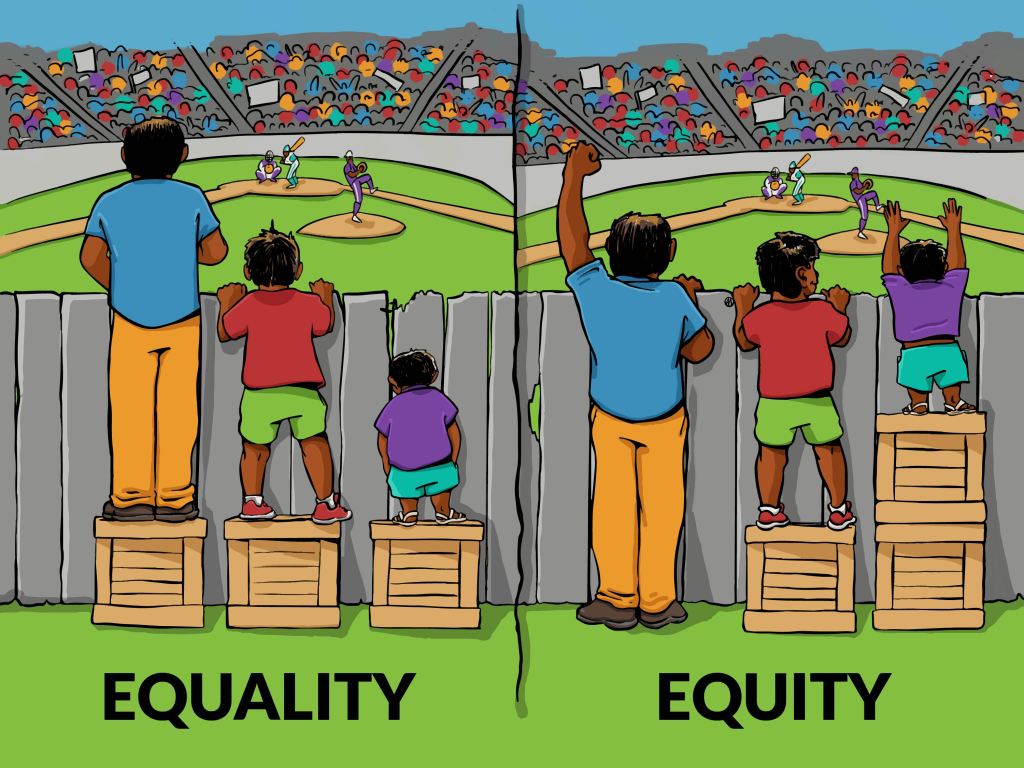
Used with permission from the Interaction Institute for Social Change (open license)
I’d like to expand the ideas about the 20% Equity Index that I discussed in yesterday’s re-post of one I did back in 2023 after hearing Dr. Ford speak at the NAGC National Convention. In her writing on equality versus equity and underrepresentation in gifted education, Dr. Ford makes one truth unmistakably clear: treating students the same does not guarantee fairness.
For decades, gifted education has relied on equal procedures. The same referral forms. The same tests. The same cut scores.
Yet the outcomes remain predictably unequal.
Dr. Ford’s 20% Equity Index is one of the most powerful contributions to the field because it moves us beyond philosophical debate and into measurable accountability. It gives educators a concrete standard for determining whether gifted programs are equitably serving students from historically underrepresented groups. It is so influential that the Office for Civil Rights has used it in investigations.
This is not simply a statistic. It is a civil rights tool.
Equality Versus Equity: The Foundational Distinction
In her Equality vs. Equity article, Dr. Ford explains that equality focuses on sameness of treatment, while equity focuses on fairness of outcomes.
Equality asks: Are all students given the same opportunity?
Equity asks: Are all students truly able to access that opportunity?
In gifted identification, equality might mean administering the same assessment to all students and assuming the process is neutral. Equity requires us to examine whether the process results in fair representation across racial, cultural, linguistic, and socioeconomic groups.
Why this matters:
If a system produces consistent underrepresentation of certain groups, then equal procedures are not equitable procedures. A neutral-looking process can still perpetuate inequity when systemic barriers are ignored.
Dr. Ford challenges the field to stop confusing equal treatment with fair access.
What Is the 20% Equity Index?
The 20% Equity Index establishes a benchmark for identifying significant disproportionality.
A subgroup’s representation in gifted education should be at least 80% of its representation in the overall student population (another way to say this is that each student group represented in a school should also be represented in the school’s gifted program within a 20% margin of the student group’s total school representation). If it falls below that threshold, the program is experiencing inequity at a level that warrants intervention.
For example:
If Black students make up 30% of district enrollment, they should comprise at least 24% of the gifted population to meet the benchmark. If they comprise only 10%, the disparity is not marginal. It is systemic.
The Index transforms underrepresentation from a vague concern into a measurable indicator of inequity.
Why this matters:
Without a benchmark, districts can acknowledge gaps while minimizing their significance. With a benchmark, inequity becomes quantifiable and harder to dismiss.
The 20% Equity Index provides clarity in a field that often relies on general statements about diversity without measurable standards.
Underrepresentation Is a Systems Issue
In her article on underrepresentation, Dr. Ford outlines persistent and well-documented disparities affecting Black, Hispanic, Indigenous, and low-income students in gifted programs. She frames these disparities as structural rather than accidental.
Contributing factors include:
• Overreliance on standardized intelligence tests • Narrow definitions of giftedness • Teacher referral bias • Cultural misunderstandings • Deficit thinking • Lack of early talent development • Inadequate family outreach
These patterns are not about individual students lacking ability. They reflect systemic barriers embedded in identification processes.
Why this matters for real students:
When a gifted students from underrepresented populations are overlooked due to referral bias, those students lose access to advanced curriculum and intellectual peers. That loss compounds over time, and is a travesty.
The 20% Equity Index highlights where these systemic barriers may be operating. Behind every percentage point is a child whose potential may not be fully developed.
Modeling Application: How a Gifted Coordinator Might Use the 20% Equity Index
Here are concrete action steps that gifted coordinators can take to apply the Equity Index to their schools (contact me if you have any questions about this since I’ve been using it in my division):
Step 1: Conduct an Equity Audit
Calculate subgroup representation in overall enrollment and in gifted programs. Apply the 80% benchmark to each student demographic group for race.
Present the data clearly and transparently.
Model language such as:
“What does our data reveal?” “Which groups meet the benchmark?” “Which groups fall below it?”
This keeps the focus on systems, not individuals.
Step 2: Facilitate Structured Inquiry
Guide faculty discussions around:
Referral patterns by teacher and school
Screening practices
Assessment tools and cut scores
Access to universal screening
Cultural responsiveness of identification criteria
Encourage staff to consider how equal procedures may still yield unequal outcomes.
Step 3: Align Practice with Research
Dr. Ford advocates for systemic solutions such as:
Universal screening
Multiple criteria identification models
Local norms
Early and ongoing talent development
Professional learning focused on equity and culturally responsive practices
The Index identifies the problem. Research informs the response.
Step 4: Monitor Progress
Recalculate annually. Equity work is not a one-time initiative. It requires sustained monitoring and adjustment.
Improvement should be measurable. If representation shifts toward the benchmark, systems are becoming more equitable. If not, deeper structural changes may be necessary.
Connecting Research to Students in Your Schools
As gifted program coordinators who work across elementary and secondary levels, we understand that identification affects trajectory.
Students identified in elementary school are more likely to access advanced middle school coursework. Those students are more likely to enroll in honors and Advanced Placement classes. Access compounds over time.
When underrepresented students are excluded early, opportunity gaps widen.
Dr. Ford’s work reframes gifted education as part of the broader equity and civil rights landscape. If gifted programming disproportionately serves already advantaged groups, it can unintentionally reinforce systemic inequities.
The 20% Equity Index is a safeguard against that outcome.
In Sum
Dr. Donna Y. Ford’s 20% Equity Index represents a shift from awareness to accountability.
It challenges the field to move beyond equal treatment toward equitable outcomes. It provides a clear benchmark that exposes systemic underrepresentation. It aligns gifted education with civil rights principles.
Most importantly, it centers students whose brilliance has too often been overlooked.
The Index does not accuse. It measures. And in measuring, it invites responsible action.
For gifted educators committed to talent development of all students, the question becomes clear: Do our programs reflect the diversity of potential in our schools?
The 20% Equity Index helps us answer that honestly.
Your Turn
Take time to reflect deeply within your own context:
• Have you calculated subgroup representation using a clear equity benchmark? • If certain groups fall below the 80% threshold, what systemic factors might be contributing? • How might equal procedures in your district still produce unequal outcomes? • What structural adjustments would be necessary to ensure equitable access?
Consider discussing these questions with your leadership team or faculty, and in the comments below so we can learn from each other.
Equity in gifted education is not a matter of intention alone. It is a matter of design, data, and deliberate action.
Dr. Ford has given us a powerful tool. How we use it will shape the future of gifted education. Please reach out to me if you’d like help using the Equity Index! ~Ann
Back at my very first NAGC Annual Convention in 2023, I got to hear Dr. Donna Ford speak. After years of reading about her ideas in textbooks and articles, I actually got to hear her speak live! Her talk was amazing, and I wrote a session reflection about it back in early 2024. Today’s post will revisit that reflection.
Why This Conversation Still Matters
The underrepresentation of Black and Brown students in gifted education has been documented for decades. Yet despite ongoing research and advocacy, meaningful change remains inconsistent across districts and states.
Dr. Ford’s session at NAGC23 served as a powerful reminder that naming inequity is not enough. Sustainable progress requires systems-level change, accountability, and a willingness to challenge long-standing practices.
About the Reposted Article
This post reintroduces my reflection on Dr. Ford’s NAGC23 session.
In her session, Dr. Ford challenges educators to address the “Dirty Dozen,” by confronting how bias, deficit thinking, outdated identification practices, and other factors continue to shape gifted programming and outcomes for our underserved students of color.
Impact on Underrepresented Gifted Students
Dr. Ford’s message has several important implications for students who have historically been excluded from gifted services:
It shifts responsibility from students and families to systems and structures.
It reinforces the importance of culturally responsive identification and programming.
It positions advocacy as a professional obligation rather than an optional stance.
How Educators and Families Can Apply This
Educators and families can use this work as a catalyst for reflection and action by:
Examining referral and identification practices for bias or gatekeeping.
Advocating for universal screening and the use of local norms.
Engaging in courageous conversations about equity within schools and communities.
In Sum
Dr. Ford’s work reminds us that equity is not achieved through intention alone. It requires sustained action, reflection, and accountability.
Your Turn
After reading or revisiting this article, what ideas or questions feel most pressing for your own context? Please add your thoughts in the comments below so that we can help each other do better for our underrepresented gifted students. ~Ann
Dr. Donna Y. Ford is one of the most influential scholars in the field of gifted education, particularly in the areas of equity, access, and culturally responsive practices. She is a Distinguished Professor of Education and Human Ecology at The Ohio State University and has dedicated her career to addressing the persistent underrepresentation of Black and Brown students in gifted programs.
Dr. Ford has authored hundreds of articles, book chapters, and books that span gifted education, multicultural education, and educational psychology. Her work consistently challenges deficit-based narratives and calls on educators to examine how bias and systemic inequities shape opportunity. Learn more about Dr. Ford’s work here. You can also listen to the National Association for Gifted Children’s (NAGC) Legacy Interview with Dr. Ford here.
Key Contribution: The Ford-Harris/Bloom-Banks Matrix
One of Dr. Ford’s most practical contributions is the Ford-Harris/Bloom-Banks Matrix, a curriculum framework that integrates Bloom’s Taxonomy with Banks’ Levels of Multicultural Content Integration. The matrix supports teachers in designing learning experiences that are both cognitively rigorous and culturally responsive. It is something that my school division hasn’t used yet, but will be exploring. You can see a sample of the matrix on Dr. Ford’s personal website.
Rather than treating multicultural content as an add-on, the matrix encourages educators to intentionally plan instruction that:
Moves beyond surface-level representation or isolated cultural references
Embeds multicultural perspectives across higher levels of thinking
Engages students in analysis, evaluation, and creation through diverse cultural lenses
Impact on Underrepresented Gifted Students
When used intentionally, the Ford-Harris/Bloom-Banks Matrix can have a powerful impact on underrepresented gifted learners:
It affirms students’ cultural identities while maintaining high academic expectations
It reduces cultural mismatch between curriculum and learners’ lived experiences
It expands access to advanced-level thinking tasks for a broader range of students
How Educators and Homeschool Families Can Apply This
Educators and homeschool parents can use the matrix as both a planning and reflection tool. Practical applications include:
Auditing existing curriculum for both rigor and meaningful representation.
Designing interdisciplinary units that integrate cultural perspectives at higher cognitive levels.
Encouraging gifted learners to critique systems, narratives, and historical perspectives.
In Sum
The Ford-Harris/Bloom-Banks Matrix demonstrates that rigor and relevance are not competing priorities. When thoughtfully combined, they create learning experiences that are both challenging and affirming.
Your Turn Think about a recent unit or learning experience you provided. Where might there be opportunities to deepen both the level of thinking and the cultural perspectives represented? What ideas do you have for using the Ford-Harris/Bloom-Banks Matrix? Share them in the comments below! ~Ann
Today marks the beginning of a periodic blog mini-series that centers on equity in gifted education. For many years, gifted education researchers have called attention to the underrepresentation of various student groups. This mini-series intentionally highlights Black scholars and practitioners whose research, frameworks, and leadership have shaped more equitable approaches to identifying, serving, and advocating for gifted and high-ability learners from historically underrepresented communities.
While the mini-series is launching during Black History Month, its purpose is intentionally evergreen. Equity in gifted education is not a seasonal conversation or a one-time professional learning topic. It is a sustained responsibility that requires reflection, action, and a willingness to examine long-standing systems and beliefs.
For decades, Black scholars have challenged narrow definitions of giftedness, exposed systemic barriers, and offered practical, research-based tools to help schools recognize and nurture talent in Black and Brown students. Their work reminds us of a truth that bears repeating: gifted potential exists across all communities, but access to opportunity does not.
This mini-series is written for educators, gifted coordinators, administrators, and others who are committed to moving beyond awareness toward meaningful, equity-driven change in gifted education.
Why This Series Exists
The persistent underrepresentation of Black and Brown students in gifted programs is not the result of a lack of ability, motivation, or family support. Rather, it reflects the cumulative impact of systemic barriers, biased identification practices, narrow conceptions of giftedness, and unequal access to advanced learning opportunities.
Research focused on equity in gifted education has existed for decades. Despite this, disproportionality in gifted identification remains a national issue, suggesting that awareness alone is insufficient. This current mini-series elevates the voices of Black scholars who have not only named these inequities, but have also provided concrete frameworks, tools, and guidance for addressing them in schools and homeschools.
National Leadership: NAGC and Equity in Gifted Education
To lay the groundwork for this mini-series, I want to spotlight our national gifted leadership organization. The National Association for Gifted Children (NAGC) has taken a clear stance that equity and excellence are inseparable in gifted education. Through its Programming Standards, position statements, professional learning opportunities, and advocacy initiatives, NAGC emphasizes the responsibility of schools to identify and serve gifted learners from all backgrounds.
NAGC’s equity-focused work highlights several core priorities that are especially relevant for educators examining their own practices:
Broadening definitions of giftedness so that they reflect diverse expressions of ability and potential
Using multiple, culturally responsive identification measures rather than relying on a single test or gatekeeper
Addressing systemic bias and structural barriers that limit access to gifted services
Supporting the academic, social, and emotional needs of gifted students from historically marginalized groups
Educators can explore NAGC’s work supporting Black students in gifted education here by reading their July 2020 statement.
Big Takeaways
Equity in gifted education is complex work, but several themes emerge consistently across research and practice:
Equity requires sustained commitment, not one-time initiatives or temporary task forces.
Systems, policies, and practices must be examined critically, rather than placing responsibility on students or families.
Representation in research, leadership, and decision-making matters deeply.
Taking Action
Moving equity from theory into practice requires intentional action at both the classroom and systems levels. Educators might begin by:
Reviewing gifted identification data for disproportionality and asking hard questions about access.
Advocating for universal screening, local norms, and multiple pathways into gifted services.
Engaging in ongoing professional learning focused on culturally responsive and strength-based practices.
In Sum
Equity work in gifted education is not optional or supplemental. It is foundational to effective talent development and educational excellence. When gifted programs fail to reflect the diversity of the communities they serve, it is a signal to examine systems, not students.
Your Turn
As you reflect on your own context, what aspects of gifted identification or programming feel most in need of closer examination or change? Share your thoughts in the comments below. Tomorrow we will learn about our first scholar- Dr. Donna Y. Ford! ~Ann




 Teaching for Talent