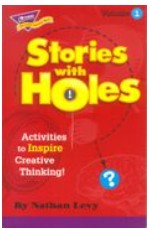
If you’re looking for a simple activity that naturally invites complex thinking, collaborative inquiry, and deductive reasoning, Stories with Holes is a classic logic game worth exploring. Created by educator and author Nathan Levy, this collection of short stories challenges students to fill in missing information using only “yes” or “no” questions. The result is an engaging way to stretch critical and creative thinking across grade levels. This short, little activity isn’t necessarily curriculum, BUT it is a resource that can be used with any grade level and any content area to challenge students to think more deeply.
What Is Stories with Holes?
Stories with Holes isn’t a typical reading passage or worksheet. It’s a set of logic stories in which an essential part of the scenario is missing—a hole. Students listen to a brief narrative and must use targeted questioning to uncover the missing context and determine the true explanation for what happened. Their questions must be answerable with yes, no, “does not compute,” or “is not relevant,” much like classic situation puzzles (see review from Bright Child Books LLC).
The game has been published in multiple volumes (e.g., Volumes 1–22) and is used widely in gifted, general, and special education classrooms because it encourages reasoning, hypothesis testing, and precise questioning.
Why This Resource Is Valuable for Gifted Learners
Gifted students often excel when tasks:
- require inference and reasoning beyond surface understanding,
- allow multiple pathways to a solution,
- and promote talk moves and justifications through discussion.
Stories with Holes checks all these boxes by requiring learners to consider alternative explanations, eliminate possibilities, and think strategically about what they don’t know yet (see information from thegiftedguide.com).
How It Works (Example Format)
Here’s the basic cadence of the activity (see this Prezi for more information):
- Read the story aloud. The teacher or facilitator presents a narrative missing crucial information.
- Students ask yes/no questions. Learners generate and take turns asking specific questions designed to reduce uncertainty.
- Track answers. Only yes/no/irrelevant/does not compute responses are given.
- Make deductions. Based on the answers, learners work toward the correct explanation.
- Reveal the solution. Once the group narrows it down or runs out of fruitful questions, the facilitator reveals the answer.
For example, a story might describe a woman who dies when the music stops—but nothing else is given. Students ask questions like “Was she dancing?” or “Was the music from a live band?” Their answers gradually narrow the possibilities, leading to a logical and surprising explanation.
How to Use It
Here are a few practical ways to implement Stories with Holes in gifted and classroom settings:
- Morning meeting warm-ups: Use a single story to kickstart reasoning and class collaboration.
- Small group challenge: Let small groups generate questions and compete for most efficient reasoning.
- Gifted pull-out sessions: Use longer or more complex stories to differentiate and deepen thinking.
- Writing reflection prompts: After solving, students write about why certain questions were more helpful than others.
- Parent engagement at home: Families can play the game together to build inquiry skills outside of school.
Because the activity only takes a few minutes per story, it’s easy to slot into your routine without needing additional materials.
Tips for Success
- Model questioning: Early on, model how to ask precise yes/no questions—avoid “why” or open-ended questions that can’t be answered within the rules.
- Encourage collaboration: Let students build on one another’s questions and reasoning.
- Add a timer: For older learners, challenge groups to solve within a set number of questions or time.
- Extend into creation: Have students write their own stories with holes and challenge peers to solve them.
In Sum
Stories with Holes is more than a fun logic game. It’s a structured think-game that naturally builds deductive reasoning, hypothesis testing, questioning skills, and collaboration—making it a timeless fit for enriched classrooms, gifted clusters, and family learning time.
Your Turn
My students used to BEG me to do Stories with Holes with them! Have you tried them with your learners? What kinds of questions surprised you or led to the biggest breakthroughs? Share your favorite stories, strategies, or adaptations in the comments below! ~Ann
 Teaching for Talent