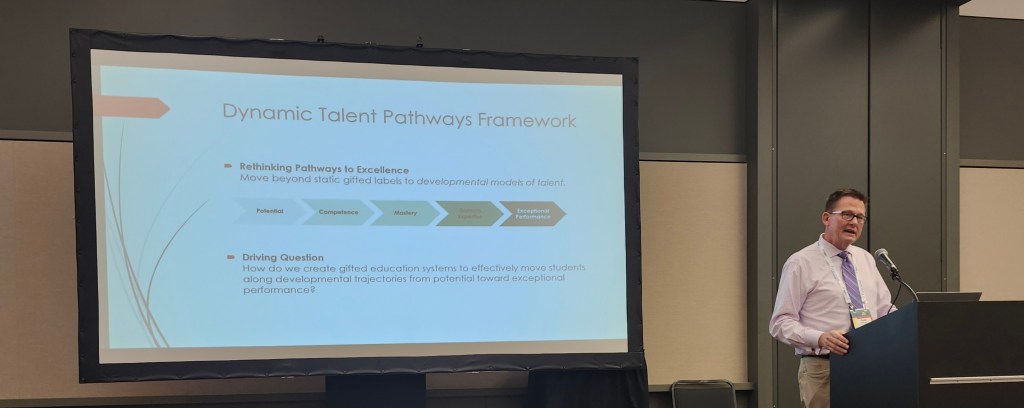
Felicia Dixon, PhD (Ball State University) and Todd Kettler, PhD (Baylor University) started this session with a reminder: in our work with gifted adolescents, our role is not to teach students what to think, but how to think. To help achieve this goal, Dr. Kettler offered a bold redefinition of secondary gifted education due to the pressures of college readiness, equity, and AI integration. His idea is called the “Dynamic Talent Pathways (DTP) Framework.” At its core is a belief that excellence and innovation are complementary, not competing- excellence reflects depth, rigor, sustained growth, and flourishing; innovation introduces new tools, structures, and partnerships that expand access to that excellence. The model merges talent development frameworks with the science of exceptional performance to re-envision secondary gifted education.
The Dynamic Talent Pathways Framework
This model pushes us beyond identification, static gifted labels, and serving gifted students toward developmental trajectories: Potential → Competence → Mastery → Domain Expertise → Exceptional Performance. The guiding question becomes: How do we move students along this pathway?
There are five theoretical frameworks upon which DTP is built:
- Differentiated Model of Giftedness and Talent (Gagné)
- The Talent Development Megamodel (Subotnik, et al)
- Ecological System’s Theory (Bronfrenbrenner)
- Developmental and Systematic Approach to Talent (Feldhusen)
- Science of Exceptional Performance Framework (Kettler)
Core Principles for Secondary Gifted Education
Giftedness in adolescence begins as early potential within specific domains, but potential alone is not enough. Talent emerges when that potential is systematically developed into competence, expertise, and a growing commitment to a field. This means secondary gifted education must focus not only on performance but on identity formation. Students need opportunities to see themselves as mathematicians, writers, scientists, and creators engaged in meaningful work. When adolescents begin to internalize these identities, they gain a sense of purpose and long-term motivation that supports continued growth.
Contextual and Ecological Talent Development
Because talent is contextual, its development depends on the ecosystem that surrounds each learner. Growth is nurtured within interconnected systems that include family, school, peer networks, community partners, and broader cultural influences. Secondary schools play a critical role as ecosystem architects by designing environments, pathways, and relationships that help students move from potential toward expertise. When these supports align, students experience the kind of sustained challenge and encouragement that allows their abilities and identities to truly flourish.
Three Interwoven Strands of Talent Development
The DTP Framework is built on three mutually reinforcing strands:
1. Cognitive Mastery
Acceleration, differentiated curriculum, inquiry-based learning, seminars, dual enrollment, mentorships, and independent research all strengthen domain-specific understanding. Metacognition and self-regulation become non-negotiable skills.
2. Creative Production
Students engage in authentic problem-solving through design labs, innovation challenges, artistic residencies, and research projects. Assessment focuses on creative contribution rather than standardized measures.
3. Identity and Purpose Formation
Through reflection, narrative work, advisory seminars, and mentoring, students connect talent to purpose and ethical engagement. Portfolios track their evolving intellectual and personal growth.
A key tool: Talent Development Plans—living documents co-created with mentors that define domain focus, short- and long-term goals, mentorship connections, and milestone experiences (performances, publications, competitions).
Context Matters: The Ecological Lens
DTP positions talent as something nurtured within nested systems—family, school, peers, community, and culture. Secondary schools function as ecosystem architects, shaping the conditions in which giftedness becomes talent.
Instructional Design & Teacher Roles
Instructionally, the model calls for inquiry and project-based learning, mentorship structures, “talent incubators,” and developmental (growth-oriented) assessment. Teachers become Talent Scouts, Learning Designers, and Developmental Mentors, supported by professional development in metacognition, affective needs, scaffolding, and creative problem-solving.
What This Means for Schools
Expected outcomes include expanded excellence, sustained engagement, equitable access, and purposeful contribution. It also invites us to rethink programs: moving away from rigidity, allowing mastery-based credit in non-strength areas, building micro-accelerations in elementary, and, above all else, prioritizing student flourishing over course collecting.
A Future-Focused Vision
The future of secondary gifted education lies in local collaboration, hybrid learning environments, data-informed talent development, and new ways of defining professional expertise. Most of all, it lies in creating conditions where gifted adolescents don’t just achieve- they thrive.
I found this presentation to be exactly what I needed to hear as my division looks at redesigning gifted programming, K-12. Therefore, this was my 3rd favorite session of NAGC25!
What do you think about Dr. Kettler’s model for secondary gifted programming? Share your thoughts in the comments below. I’d love to hear from you! ~Ann
P.S. By the way, in case you don’t know, Dr. Felicia Dixon is the mother of secondary gifted education! She is the primary editor of The Handbook of Secondary Gifted Education, with the 3rd edition coming out any day now!
 Teaching for Talent
2 thoughts on “#NAGC25 Session Review: Excellence and Innovation in Secondary Gifted Education”