Presented by Susan Corwith, PhD and Eric Calvert, EdD, from the Northwestern University Center for Talent Development

One of the biggest challenges in gifted education is not simply designing strong services- it’s building the shared understanding and buy-in needed to make those services work. This session offered a powerful, practical roadmap for aligning Talent Development to MTSS (Multi-Tiered Systems of Support) so schools can support advanced learners equitably and coherently.
What Is MTSS?
MTSS is a system of supports using data-based decision making to ensure a high-quality education for all students (I love this definition of MTSS)! And it does far more than deliver interventions:
- It coordinates how academic, behavioral, and SEL systems fit together.
- It ensures equitable access to challenge, support, and acceleration.
(Note: For further information about MTSS, I gave an in-depth discussion of it in my blog post entitled #NAGC25 Session Review: MTSS, IEPs, and AI: Oh My! Rethinking Support for Twice-Exceptional Learners).
Where to Start? With the Zone of Proximal Development (for information about ZPD, click here)
If our goal is to maximize growth of our gifted and advanced students, we must ask two essential questions:
- Where should advanced learners spend most of their time?
In their Zone of Proximal Development, working at the edge of their current competence with appropriate challenge. - Where do they actually spend most of their time?
Too often below their readiness level, repeating mastered content or waiting for the rest of the class.
MTSS and Talent Development help close this gap by structuring challenge, support, and opportunity intentionally across a schoolwide system.
Building the Buy-In
A strong system begins with shared clarity and shared responsibility. The presenters cited Tamra Stambaugh, who emphasized that a robust continuum of services is essential, and it must be both horizontal and vertical. Horizontal services ensure that students have a range of opportunities and supports within their current grade level, while vertical services create an articulated path from one level to the next so students don’t lose momentum during transitions. Both dimensions depend on clear, written plans that are understood and embraced across the school community. A continuum matters because students’ learning and developmental needs vary widely, and without a thoughtful structure, we risk mismatching students with services. When done well, a continuum allows us to intentionally align environments, experiences, and supports so every learner can grow at the appropriate pace and depth.
Why Apply MTSS to Advanced Learning?
Districts increasingly recognize that MTSS is ideal for supporting advanced learners because:
- It’s a model familiar to educators and leaders.
- It frames challenge as a shared, schoolwide enterprise rather than the job of one gifted teacher.
- It prioritizes an asset map—what strengths and services already exist in the system and who is responsible for leveraging them.
- All students benefit when they have opportunities to explore interests and develop strengths.
- Tiers allow for flexibility and equity across readiness levels.
- It supports integration of SEL, which is essential for talent development.
The Talent Development Framework and How It Aligns to MTSS
A Talent Development (TD) approach centers on nurturing students’ emerging abilities through domain-focused development, domain-specific growth trajectories, and the understanding that giftedness is something that evolves over time rather than being a fixed trait. It emphasizes deliberately cultivating the psychosocial skills students need to thrive and creating clear pathways that lead toward genuine creative productivity. This approach strengthens MTSS by focusing on developing potential and latent talent, aligning closely with current research on learning, problem-solving, and creativity. Most importantly, TD keeps educators anchored in a strengths-based perspective, especially for underrepresented learners, so that growth for all students becomes both the priority and the expectation.
What Might a Continuum Look Like in Your District?
Dr. Corwith and Dr. Calvert suggested that if we wanted to move to a TD/MTSS continuum in our districts, we should start with looking at our student data to identify students’ relative strengths, readiness levels, and areas needing additional challenge. Then, we can map services to those needs:
- Tier I (for ALL): Interest-based learning, strength-based opportunities, embedded enrichment
- Tier II: Extension opportunities, enrichment, subject-specific acceleration
- Tier III: Targeted, intensive services for students with complex or lower-incidence advanced learning needs
- Across all tiers: Social-Emotional Learning (SEL) supports that cultivate student agency. Dr. Calvert reminded us that there is no single social-emotional profile for gifted students. Many characteristics commonly attributed to “giftedness” are learned behaviors—perfectionism, for example, is not an inherently gifted trait (Syvia Rimm talks about perfectionism here).
Another suggestion for the TD framework is that malleable psychosocial skills must live in Tier I, so all students learn skills like persistence, collaboration, self-regulation, and intellectual risk-taking.
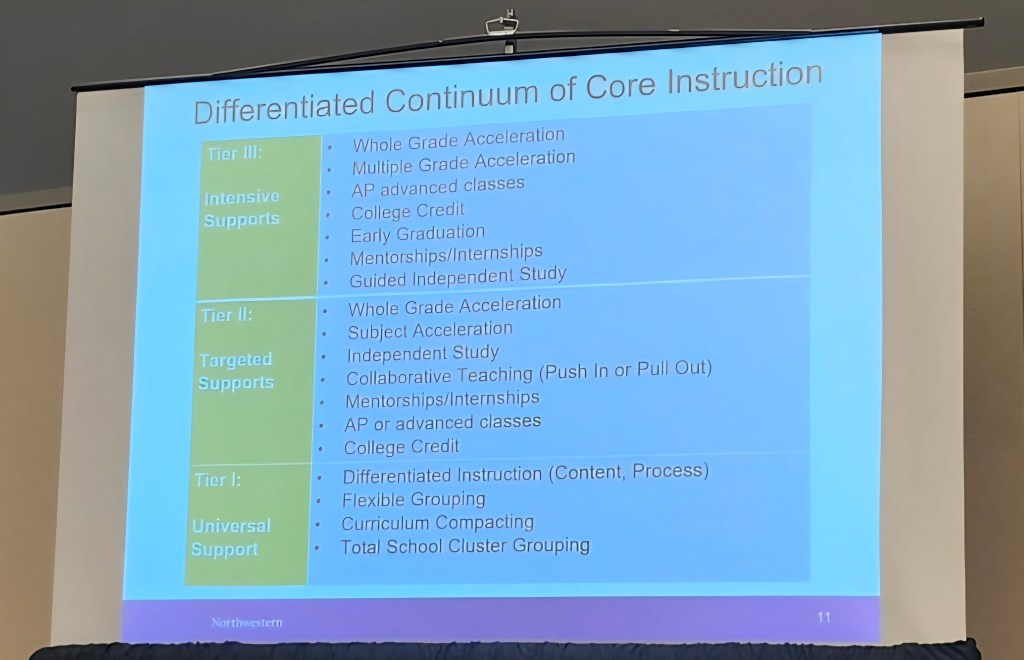
Dr. Calvert shared the idea that districts should offer differentiated continua of services in multiple areas: Core Instruction, Enrichment, Assessment, and Psychosocial Supports. Here is a the example of the Continuum of Core Instruction he gave:
Range-Finding: How Extensive Should the Continuum Be?
Districts can use assessment data to determine how far services need to stretch and which learners fall within each zone of readiness. This process becomes especially important because gifted students often have “peaky profiles” (meaning that their strengths are uneven rather than uniformly high). For students whose readiness levels sit far beyond what typical grade-level grouping can offer, acceleration should be strongly considered. The presenters referenced Peters (2017) who encourages us to ask whether teachers can effectively serve students functioning more than two years above grade level; when the answer is no, acceleration becomes not just appropriate but necessary.
Differentiation + Acceleration = Increased Effectiveness
Differentiation becomes significantly more powerful when paired with the right type of acceleration (see my prior discussion about acceleration in my blog review of the Subject Acceleration session; I discuss some of the forms of acceleration that a school district could use). Subject or whole-grade acceleration does not replace differentiation—it enhances it. One way to think about this is through the idea of ZPD × 2: bringing a student’s zone of proximal development inside the teacher’s “zone of possible differentiation.” When acceleration adjusts the starting point, differentiation can operate more effectively and responsively.
Conclusion: Challenges and Opportunities
Implementing a Talent Development approach within MTSS comes with real challenges. Many educators still view MTSS as a structure designed only for special education, a misconception left over from early Response to Intervention (RtI) models. Teachers often need deeper professional learning to differentiate effectively, and schools require clear, efficient policies to guide academic acceleration. Some divisions may also need to expand the courses they offer or rethink how services are organized so that staff are supported rather than overwhelmed. And the reality is that a single gifted teacher in each building cannot meet every need—distributed teaching and shared responsibility are essential.
At the same time, the TD Framework holds remarkable opportunity. Schools can move away from outdated assumptions such as fixed ability or narrow, stereotypical views of gifted learners. They can shift from relying primarily on pull-out services to embracing more comprehensive, schoolwide talent development practices. Families can see that updated service models actually expand opportunities for advanced learning rather than reduce them. Diverse schools, especially those previously disadvantaged under NCLB-era accountability structures, can finally demonstrate the depth of student growth that traditional measures often missed. Most importantly, schools can build a sustainable, consultative approach that supports every learner in discovering strengths and developing talent.
Final Thoughts
This session was another one of my favorites from the convention. Talent Development is near and dear to my heart, and one of my passion areas in the field of gifted education. When I put together all that I learned from Dr. Corwith’s and Dr. Calvert’s session, it seems clear that implementing Talent Development within an MTSS framework isn’t about adding another initiative (MTSS is typically the way schools “do business” anyway). It’s about reimagining how we cultivate potential across an entire system. When schools commit to a continuum of services, embed psychosocial skill development in Tier I, and leverage acceleration and differentiation strategically, they create environments where advanced learners can thrive. With shared responsibility, clear processes, and strong professional learning, MTSS becomes a powerful pathway for equitable, sustainable, and high-impact gifted education.
 Teaching for Talent
One thought on “#NAGC25 Session Review- Building Collaboration and Buy-In: Talent Development Services that Leverage MTSS”