This session was HANDS-DOWN one of my favorites that I attended! I learned so much (plus I’m a huge Emily Mofield fan), and I plan to take back everything all my new knowledge to my Gifted & Talent Development Resource Teachers team.
At this year’s NAGC conference, Dr. Emily Mofield (Lipscomb University) and Dr. Brian Housand (University of North Carolina- Wilmington) delivered a session that felt both energizing and grounding. They had a reassuring message for us: the real power of artificial intelligence is found in our ability to remain authentic humans and to help our students do the same. While many educators worry about AI diminishing critical thinking or stripping away authenticity, Dr. Mofield and Dr. Housand showed us how AI can strengthen, not weaken, the traits gifted learners already possess.
Their framework centers around four superpowers our gifted students have that AI does not: courage, curiosity, wisdom, and discernment. When we use AI intentionally, these superpowers grow stronger. When we design tasks that require students to stay in the driver’s seat, AI becomes the sidekick and our gifted learners become the superheroes.
Below is an overview of each superpower and the opportunities they offer.
Courage
Productive struggle is at the heart of gifted growth (see my blog post review about motivation and optimal brain development for more information about this). Courage is what allows our students to stay in the struggle long enough to learn something meaningful. Dr. Mofield demonstrated how we can use AI to make productive struggle visible and purposeful by building custom bots that elevate rigor.
By programming bots with Kaplan’s Depth and Complexity icons, Paul’s Elements of Reasoning, universal themes, and literary analysis tools, she created a Socratic Seminar bot with four personas- The Curious Connector, the Text Detective, the Big Idea Builder, and the Respectful Challenger. These personas push students to consider multiple viewpoints and develop stronger arguments.
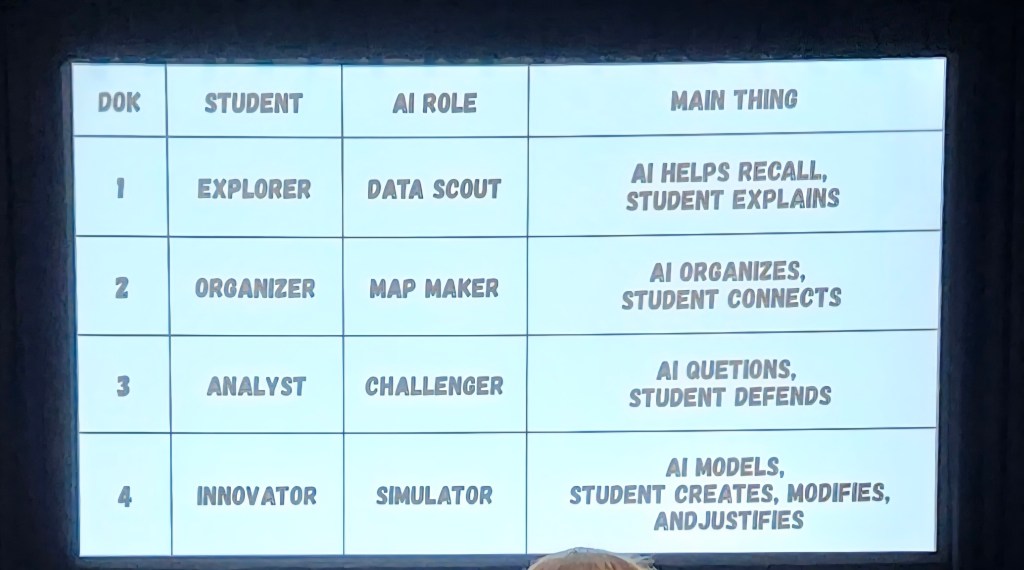
In this model, the student plays the lead role. AI becomes the data scout, map maker, challenger, or simulator. The student explores, organizes, analyzes, and innovates while AI offers structure or intellectual friction. It is a perfect way to ensure that the student is doing the THINKING and that AI is doing the SUPPORTING.
Some suggestions Dr. Mofield gave for helpful prompts for courage are:
- Write an argument that disagrees with mine so I can respond.
- Give me three perspectives that challenge my view so I can decide which one to address.
A quick courage checklist:
- Are students wrestling with ideas rather than receiving them?
- Does the task require evidence, reasoning, or revision?
- Does AI push the thinking in some way?
Curiosity
Dr. Housand kicked off the next part of the session by telling us that, “Curiosity may not kill the cat after all because satisfaction brings it back.” Our gifted learners are wired to wonder, question, and follow their ideas into unexpected places. Dr. Housand framed this as joyous exploration, the pure desire to seek new information and experience the joy of learning.
AI can either shut curiosity down or open it up. The key is to use AI as a question builder rather than an answering machine. A simple prompt like “Pose five intriguing questions about ____ that do not have simple answers” immediately shifts the task from recall to wonder.
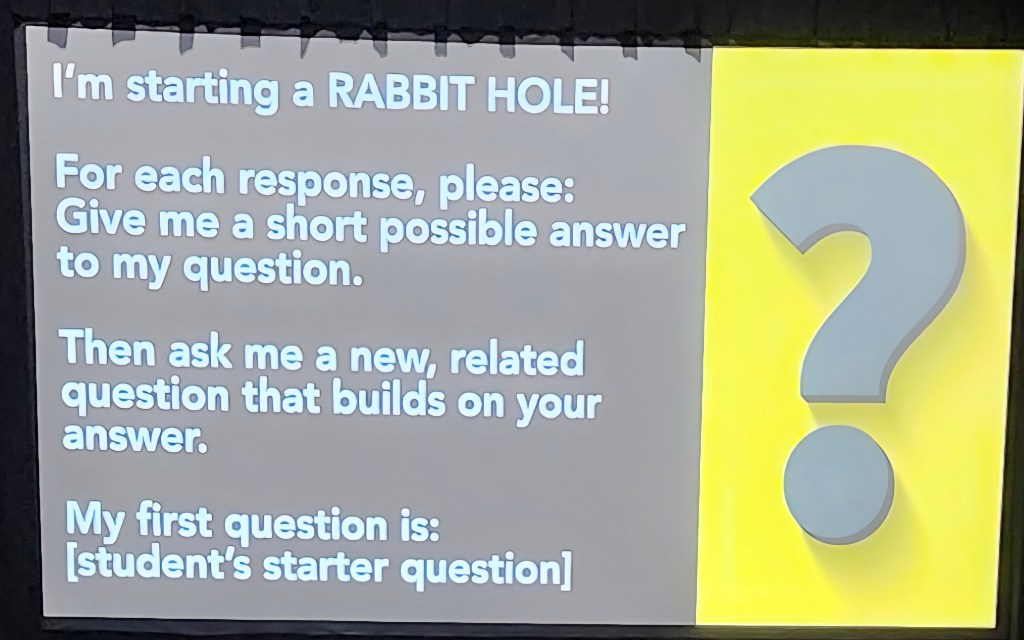
Dr. Housand introduced the “Rabbit Hole OS” inspired by the “5 Whys” questioning technique used by Toyota founder Sakichi Toyoda. This mini-system guides learners deeper into their own questions instead of speeding toward quick answers.
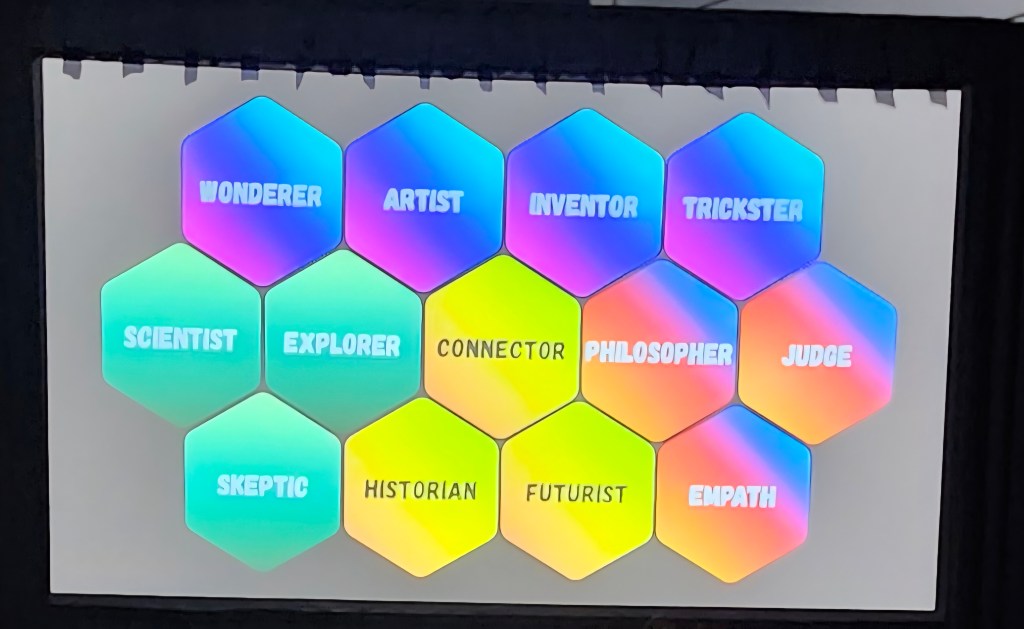
He also shared the Curiosity League, a playful framework with thirteen personas that model creativity, synthesis, discovery, and meaning making. From the Wonderer to the Historian to the Skeptic, students can try on different ways of being curious with AI as a supportive partner. (Sidebar- he has a book about this coming out soon. I can’t wait to get it!)
A curiosity checklist:
- Are learners asking questions that lead to discovery?
- Are they in the driver’s seat?
- Does AI extend their wonderings?
- Are students encouraged to follow their curiosity?
Wisdom
One of the hallmarks of gifted education is helping students to build expertise and think like practitioners. Wisdom helps them use metacognition to evaluate their choices, tools, and strategies. Dr. Mofield and Dr. Housand reminded us that teaching is a series of invitations into the hero’s journey. Every academic task is a call to adventure, followed by a test of power, and ultimately a transformation.
They encouraged students to ask reflective questions at each stage:
Call to Adventure
- What do I already know?
- What is my goal?
- What role should AI play?
Test of Power
- What new questions does this raise?
- What did AI add that I had not considered?
- Where do I disagree with AI?
Transformation
- How has my learning changed?
- What will I do differently next time?
- How did AI shape my next steps?
AI can also act as a “Meta Mate” (I love this term!) with prompts like:
- Ask me questions that make me reflect on my reasoning.
- Help me identify gaps in my argument.
A wisdom checklist:
- Are students reflecting on their thinking before, during, and after using AI?
- Are they critiquing AI instead of accepting it?
- Are they comparing their ideas to AI’s suggestions?
Discernment
Discernment asks three essential questions. Is it true? Is it meaningful? Is it mine? He shared a powerful quote with all of us from the book, Future Shock by Alvin Toffler (note: this is an Amazon Affiliate Link from which I make a small commission): “The illiterate of the twenty-first century will not be those who cannot read and write, but those who cannot learn, unlearn, and relearn.”
This is SO important for us as educators to understand so we can help our students be master discerners. In a world where AI can sound confident even when it is wrong, gifted learners need strong internal filters. To help students practice discernment, Dr. Mofield and Dr. Housand offered a simple process: Wait. Wonder. Weigh. Discernment teaches students to pause before they accept information.
They also encouraged students to explore multiple sides of an issue by generating two opposing persuasive arguments. This helps students notice assumptions, missing information, questionable evidence, and attempts to influence tone.
Helpful reflection questions include:
- What assumptions is AI making?
- What is being left out?
- Who might be persuaded by this viewpoint?
- What will I remember the next time I read something from AI?
A discernment checklist:
- Are students evaluating information for credibility and bias?
- Are they weighing multiple perspectives?
- Does the task reward slow, thoughtful reasoning over fast answers?
- Is AI being used to challenge assumptions and deepen understanding?
Final Thoughts
I really loved the metaphor of the hero’s journey that was used throughout much of this presentation. As Dr. Mofield and Dr. Housand told us, in every hero’s journey there is always a mentor. In gifted education, that mentor is us! When we teach our students to use AI with courage, curiosity, wisdom, and discernment, we create thinkers who remain unmistakably human. AI may be the sidekick, but our gifted learners are always the superheroes.
So, what do you think about this information? How are you handling AI with your gifted students? What challenges and wins have you had? Please share them in the comments below so we can all learn from each other! ~Ann
 Teaching for Talent
One thought on “NAGC25 Session Review- Thinking Outside the Bot: Leveraging AI to Develop Gifted Superpowers”