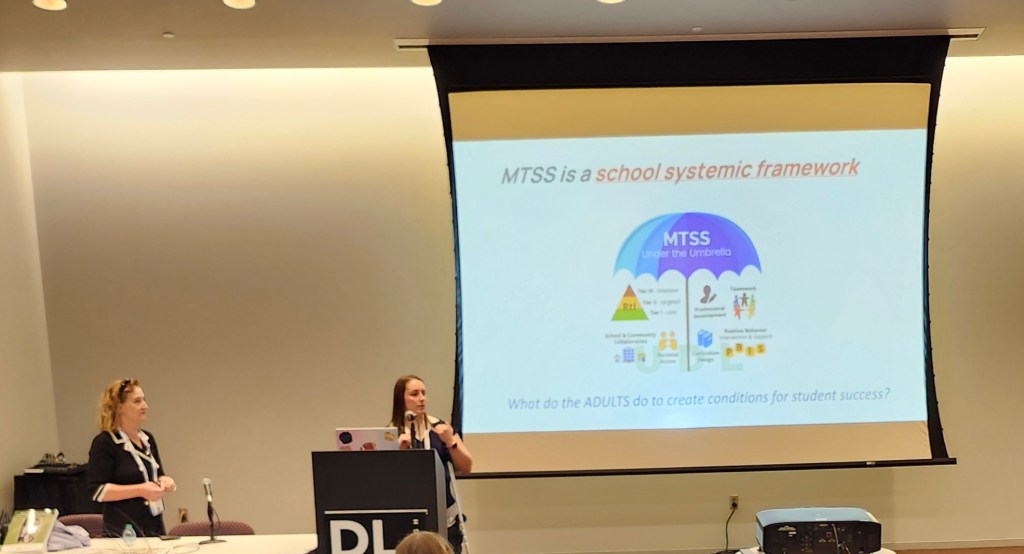
I was looking for a session to help me bring back fresh ideas about how we can better support twice-exceptional learners, and this one was a standout at #NAGC25! Dr. Claire Hughes (Cleveland State University) and Sheyanne Smith (Nebraska Department of Education) blended research, systems thinking, and real-world educator experience into a clear message: Our MTSS processes, language, and IEP practices must evolve if we are serious about meeting the complex needs of our 2e students. And the good news? We are closer than we think.
What is MTSS?
MTSS stands for “Multi-Tiered Systems of Support.” It is a framework of proactive tiers of support to meet students’ needs wherever they may lie. Tier I encompasses high-quality core curriculum and instruction for all (universal). Tier II provides supplemental interventions for those who need it (targeted). Tier III serves students who have the greatest academic or behavioral needs (intensive intervention). MTSS is for all students; every educational, social-emotional, and behavioral need can be served through the MTSS model. When MTSS is implemented with fidelity, the effect size of its use with students is 1.09, meaning that students served with the proper interventions within the MTSS model will see MORE than one year’s growth for one year’s worth of time! (Almarode, J., Hattie, J., Fisher, D., & Frey, N. (2021). Rebounding and reinvesting. Where the evidence points for accelerating learning. A GOLD paper. Thousand Oaks, CA: Corwin.)
Understanding Twice-Exceptional Learners: Ability + Disability
Hughes grounded us in a simple definition of twice-exceptional (2e): twice-exceptional learners show evidence of both ability and disability. Because of the well-known masking effect, one can easily hide the other. These students have very real learning challenges, and they also bring tremendous assets to their schools. Our systems must recognize both.
Shifting to a Strengths-First Lens
A central theme of the session was the power of strengths-based thinking. Instead of focusing on what students cannot do (a deficit mindset), strengths-based approaches intentionally look for talents, capabilities, and positive attributes. This shift is not fluffy. It has a real impact on student motivation, confidence, and engagement.
The presenters pushed us to examine our own language. Are we unintentionally sending messages that limit students’ potential? They challenged us to replace phrases like “students with deficits” with:
- Students with emerging needs
- Students with advanced learning needs
- Supports for meeting grade level standards and beyond
- Individualized learning pathways
Every part of our system communicates our values, including manuals, agendas, and templates, so we should check all of it for deficit language.
Introducing the 5F Framework for IEPs
Hughes and Smith offered a refreshingly organized way to think about the IEP process: the 5F Model, a cycle grounded in intentionality and student-centered planning.
Framing – Building a shared understanding of the student’s unique profile
Finding Strengths – Identifying talents, interests, and capabilities
Formalizing Supports – Situating supports within the MTSS structure
Forging Goals – Creating goals that both reduce barriers and build strengths
Fulfilling Plans – Implementing plans with the right level of resources and monitoring
They argued that most IEP teams spend too much time on wordsmithing and not enough time on problem-solving. Their “IEP wish list” was refreshingly realistic:
- Goals come directly from student data
- Strengths drive everything
- The team’s time is spent thinking, not formatting
- AI handles the heavy lifting
MTSS: A System Built for Flexibility
One of the most important takeaways: MTSS is a framework, not a label, and when MTSS is done properly, it can serve every student exactly how he or she needs it. Hughes and Smith reminded us that supports are tiered, but students are not.
MTSS should respond to the student, not their eligibility category. A label is not required for a learner to receive help. In fact, Hughes spent time in the United Kingdom, and she said that she learned that in the U.K., students do not need a label at all before services begin.
The presenters also advocated for a more unified MTSS graphic, such as a single stacked pyramid instead of the classic MTSS diamond. Gifted education, special education, and general education belong within the same flexible, responsive framework. Many school divisions do not see the power of serving gifted needs through the MTSS model. I often tell my teachers and principals that gifted education and talent development is part of the continuum of services for all students, and should be firmly addressed through MTSS, as well.
A strong MTSS system improves:
- Identification of advanced and struggling learners
- Access to enrichment and challenge
- Responsivity through teaming, data, and progress monitoring
- Educational equity, ensuring students receive what they need when they need it
The Role of AI: Efficiency, Not Replacement
AI came up as a practical tool for:
- Locating resources and research for 2e IEP development
- Drafting asset-focused IEP goals
- Streamlining template creation
- Improving team efficiency
With the right prompts, AI can help teachers reduce paperwork, stay student-centered, and create more consistent, strengths-based plans.
Moving Forward Together
Hughes and Smith emphasized the need for:
- Specialized training for educators working with 2e learners
- Professional learning aligned to MTSS and NAGC Programming Standards
- Intentional local planning that connects district strategic goals to gifted programming
Their closing message was one I will not forget: “Every 2e student deserves an educational plan that celebrates their strengths.”
This reminder, one I plan to bring back to my division, may be the most important: “We need to stop asking whether the student is responding to the system and start asking whether the system is responding to the student,” (from the Nebraska MTSS website).
What a powerful charge for all of us working in gifted education, special education, and MTSS! This was an exceptional session from start to finish!
What are your thoughts about the ideas I reviewed in this blog post? How does your division address 2e learners? Leave your thoughts and ideas in the comments below. Let’s have a conversation! ~Ann
 Teaching for Talent
2 thoughts on “#NAGC25 Session Review: MTSS, IEPs, and AI: Oh My! Rethinking Support for Twice-Exceptional Learners”