
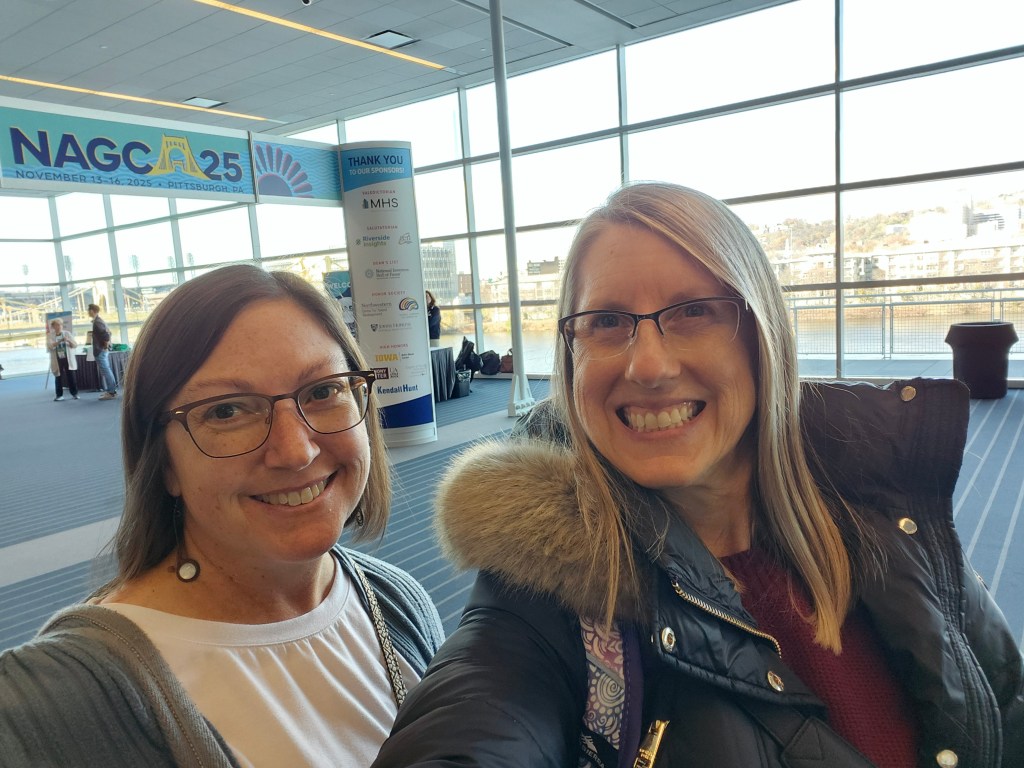
So, the wait was finally over and NAGC25 was here! My colleague and I arrived in time to settle into the Ballroom of the David L. Lawrence Convention Center in Pittsburgh, PA, for the #NAGC25 opening keynote address (see us below!). The keynote was inspiring and provided a perfect message for all of us to kick off the conference!
I found myself laughing, nodding, and occasionally tearing up during Dwayne Reed’s keynote, “Being the Educator They Need.” If you’ve ever heard Teach Mr. Reed speak, you probably already know that he brings heart, humor, and a fierce belief in kids to every room he enters. This was my first time hearing him speak, and it was the first time I ever heard his viral song, “Welcome to the 4th Grade” (it was GREAT, by the way). His talk wasn’t about strategies, frameworks, or academic outcomes. It was about us- the humans in front of gifted children every day- and how who we are shapes what they can become.
As gifted educators, homeschool parents, and coordinators, we spend so much time designing high-level tasks, identifying potential, and nurturing talent. But Mr. Reed reminded us of a truth we sometimes forget: before we can challenge our students’ minds, we must connect with their hearts.
Or as he put it: “We must Maslow before they can Bloom.”
Mr. Reed gave the gifted educators in the room three very important tips to help us keep relationships first:
Tip #1: Who Am I? The First Question Every Educator Must Answer
Reed began with a simple but profound challenge: Kids can only make sense of who we are based on what we reveal about ourselves.
And wow, did that resonate.
When I was a child, I was endlessly curious about my teachers. Did they have kids? Where did they go to college? Did they like softball as much as I did? Back then, teachers rarely shared anything personal. So when I became a teacher, I made a decision: my students would know me as a person: my hobbies, my family, my quirks, my love of learning… I let them all in on my life!
And it changed everything.
Year after year, my strongest classroom moments came not just from unit plans or carefully crafted lessons, but from relationships- genuine, mutual relationships. Reed summarized this beautifully through Rita Pierson’s famous line:
“Kids won’t learn from people they don’t like.”
When students know us, they trust us, and trust is the foundation of challenge, risk-taking, creativity, and rigor, especially for gifted learners who can sometimes feel misunderstood or feel afraid to take a chance. I, myself, often tell teachers and principals that strong relationships are the foundation of achievement for kids.
Tip #2: Who Are They? Understanding Their Stories
After we understand ourselves, we must turn toward the children in front of us. Mr. Reed challenged us to ask: “Who are they?”
What are their passions? Their triggers? Their excitements? Their fears? Their stories?
Each gifted student carries a unique set of strengths and complexities. He spoke candidly about what some of our students face at home:
- Abandonment
- Abuse
- Drug exposure
- The foster system
- Violence and gang pressures
- Food insecurity
- Depression
- Suicidal ideation
The room was silent, and I instantly reflected about former students of mine who dealt with many of the situations Mr. Reed listed.
And then he said something I hope every educator remembers:
“We should not be meeting trauma with trauma; we need to meet trauma with compassion.”
We can’t always fix their circumstances. But we can meet them where they are. We can listen. We can follow up. We can show up consistently.
Tip #3: Who Are We? Building the Collective “We” in a Classroom
The final question Mr. Reed posed might be my favorite: “Who are we together?”
A classroom is not simply a group of individuals. It is a family in progress, a community we intentionally create. Mr. Reed reminded us that the difference between a good teacher and a great teacher isn’t charisma or cleverness. It’s intentionality!
We don’t build belonging by accident. We build it by choosing it. He gave us some ideas for being intentional, some of which were:
- Greet students every day at the door- with their name, a smile, a handshake, or a fist bump,
- Play games with your class (the goofy ones usually work best), and
- Apologize when you mess up (model humanity).
Mr. Reed also reminded us that relationships don’t stop at the classroom door. Showing up for kids at sports events, recitals, birthdays, and community spaces builds trust in powerful ways- especially for gifted students who thrive on connection and recognition.
The Lasting Impact
As Mr. Reed closed, he reminded us that the lessons we teach stretch far beyond our walls. Our presence, our intentionality, and our belief in our students become memories they carry into adulthood. This concept really hit home for me since just this past summer, a former student of mine from almost 15 years ago reached out to me through my website. His email flooded me with emotion, and it validated my instinct so long ago to be real with my students:
“I just wanted to say hi and thank you. You were such a pivotal role model in my life while so much was hectic in my own home and you always believed in me and encouraged me to reach my full potential. Thank you for always being the authentic you and I’m so happy to see you excelling in life!”
Gifted kids, in particular, feel deeply. They remember who championed them, who saw them, who cared enough to understand their quirks, passions, sensitivities, and potential. And they remember who was there for them even if they don’t tell you how much they need you.
And that’s why this keynote by Dwayne Reed resonated with me so much.
Because being “the educator they need” isn’t about perfection. It’s about presence.
It’s about seeing and being seen. It’s about choosing connection every single day.
Don’t ever forget the power of a strong relationship with your gifted students.
What stories do you have about the deep connections you might have made with a student? Share them in the comments below. I’d love to read them! ~Ann
 Teaching for Talent
One thought on ““Being the Educator They Need:” Reflections from Dwayne Reed’s NAGC25 Keynote”