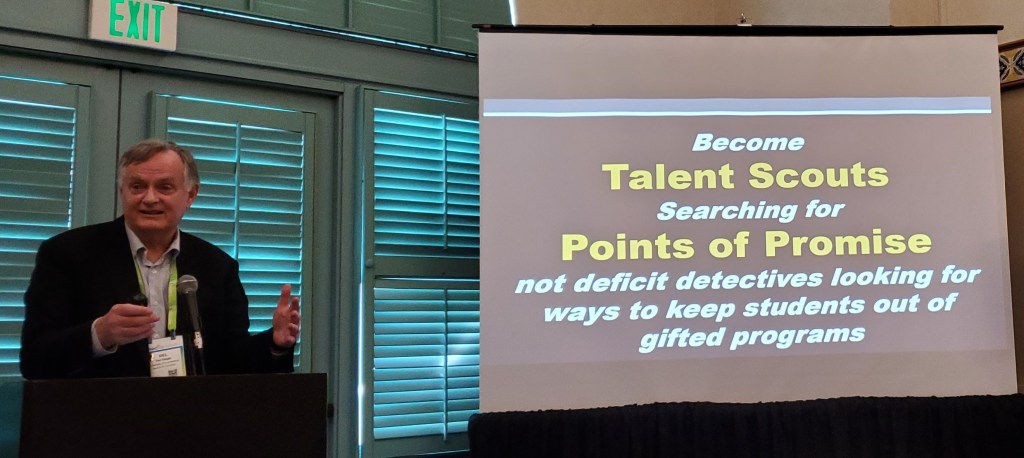
Another informative session I attended at NAGC last November was by Dr. Del Siegle and Dr. Betsy McCoach called, “Research to Guide Practice: Findings from the National Research Center That Practitioners Need to Know” (11/10/23).
Drs. Siegle and McCoach are two of the heavy hitters in the field of gifted education. They shared a plethora of research over the years from the National Research Center for gifted education that is housed at the University of Connecticut, where they both are professors. Here are some of the big take-aways based on NRC research that I had…
Underrepresented Populations in Gifted Programs, In General
What works based on the research?
- Conduct universal screening AND consider achievement data [not just ability data] to address this gap in identification.
- Address achievement gaps early since 3rd grade academics accounts for much of the under-identification we see.
- Since NO combination of cognitive ability scores, achievement scores, and teacher ratings completely addresses the equity issues we have, we can:
- Use local norms if we have homogenously populated schools (does not work with economically balanced schools)
- Use “OR” instead of “AND” to expand criteria
- Provide yearly training on teacher rating scales since there is so much variability between teacher ratings.
Successful English Learner Gifted Identification
What works based on the research?
- Universal screening
- Alternative pathways for identification
- Establish a web of communication with home and school
- View Professional Development as a lever for change (side note- it warmed my heart to hear them share this tip since I firmly believe it)
- Screen EL students for gifted if they move quickly through the EL program.
Other Interesting Research Findings
- Requiring differentiation is important since it is critical for every student (YES!).
- Allow some teacher autonomy to adjust pacing guides as needed for their students.
- Gifted services MUST align to gifted identification (Determine program outcomes > Design program > Design ID for the program)
- Are there benefits of gifted programs beyond achievement? One study about gifted boys- they typically go to college, take more AP courses, graduate on time, and have higher high school math GPAs.
Overall, it was very interesting to me to learn about these practical, research-based suggestions for increasing diversity in our gifted programs. Does your school division use any of these tips?
 Teaching for Talent
One thought on “Research to Guide Practice: Findings from the National Research Center”